A drain is sometimes considered a negative word associated with depletion, exhaustion and loss of resources.
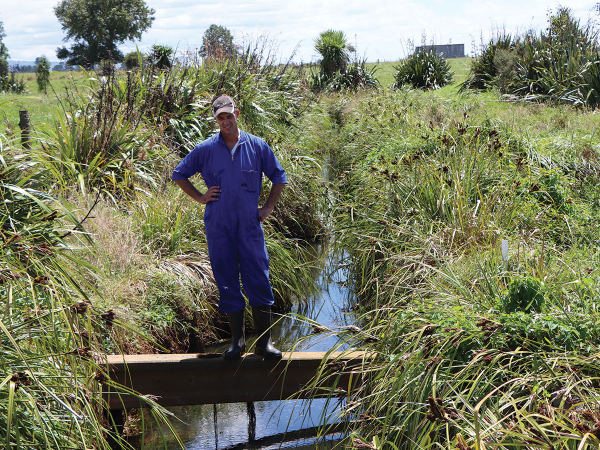
It’s a word that Johan van Ras no longer uses on his Te Pununga dairy farm, which lies in the Waihou-Piako flood management area.
“It is not a drain,” says Johan, who is constantly looking for ways to make environmental improvements on his land, including to water quality and native habitat.
“It’s a managed waterway that has been straightened for the function to remove water, but it’s an actual stream with wildlife in it.”
Johan is one of 14 landowners involved in Waikato Regional Council’s Thames Valley channel diversion planting programme that was started in 2024 to address the significant bank erosion and slumping that occurred in the Waihou-Piako land drainage network during heavy flooding in 2022/23.
The council received $1.08 million from the Regional Infrastructure Fund, administered by Kānoa Regional Economic Development & Investment, towards the $1.8m programme to help improve the overall performance of the Waihou-Piako flood protection scheme.
Work includes reshaping about 15km of drains and planting them out in bank-binding native sedges (Carex) so they can effectively clear surface water from farmland without introducing high sediment loads to the Piako and Waihou river systems.
Previous trials by the council and other organisations show benefits of reduced maintenance requirements (weed spraying and mechanical excavation) and improved water quality (greater clarity, cooler temperatures and higher dissolved oxygen levels).
“It’s the right thing to do,” says Johan, who himself heeded the research and planted sedges along one of the drains on his property (the Te Puninga Stream) before taking part in the council’s programme to plant out the rest.
“I used to call them drains, and they were filled with weeds, their banks eroding. I had posts that fell in, I had cows fall in – they’d graze hard up to the stream.
“We were part of the drainage network process of spray, dig, spray, dig, to control the weeds and to dig out the layer of sludge that would build up. This would then expose the banks and if a large flood came through, they’d collapse.
“Now, I can just forget about it.”
Johan says the New Zealand sedges grow fast and “are insane at holding the banks together”, but they also create shade which suppresses weeds and cools the water for native fish species.
eDNA monitoring on his property has revealed banded kōkopu and shortfin eels, and Johan is waiting for the return of longfin eels and kōura from his restoration efforts.
“There is life here now in an area that was once unproductive and had no native habitat values.
“Now we have kōkopu, eels, inanga, birds; you can hear the insects. It’s awesome.”
Waikato Regional Council Integrated Catchment Management director Greg Ryan says the Thames Valley channel diversion planting programme is an example of how the council considers nature-based solutions, where feasible, as part of its flood protection maintenance and renewals programme.
“We take a whole catchment approach to support our core business of managing water, so that includes planting to reduce erosion and VOSsedimentation and improve water quality and habitat and replacing or upgrading pump stations with fish-friendly ones. For some of our big flood management projects, we’ve also created wetlands and water refuges for native fish species.”
Inger Vos is a communications partner at Waikato Regional Council.