
Karen Williams named Irrigation NZ CEO
Former Federated Farmers national vice president Karen Williams has been appointed the new chief executive of Irrigation New Zealand.




 increase font size
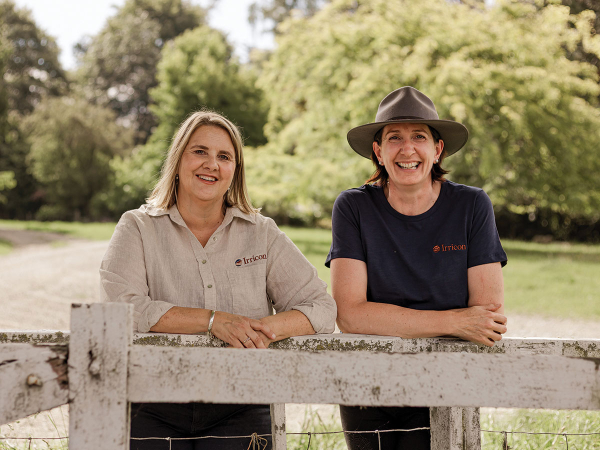 Irricon founder Keri Johnston (right) and managing director Haidee McCabe.
New Zealand's food and fibre sector is entering a period of significant transition and Irricon's refreshed brand reflects how both the business and the sector it supports have evolved, says director Keri Johnston.
"Land and water decisions have always mattered, but the environment farmers are operating in today is fundamentally different," says Johnston.
"Water, environmental performance, market expectations and farm succession are all converging at once. Farmers and growers are managing compliance, but they're also making long-term business decisions in a changing world."
Johnston says while the pace of change can feel challenging, it also creates opportunities for those willing to plan ahead.
"There's a strong appetite across the sector for practical pathways forward. People want clarity, not more complexity. They want advice that helps them understand what's coming and make confident decisions now, rather than reacting later."
She says water management is increasingly central to that conversation.
"Water security underpins productive farming systems, resilient communities and future market access. If it's done well, environmental planning isn't a constraint. Rather, it can strengthen businesses and protect options for the next generation."
Irricon's rebrand marks an important milestone for the Timaru-based environmental consultancy, which has grown alongside the changing needs of rural New Zealand.
Founded in 2007 by Keri Johnston, Gary Rae and Paul Sullivan, Irricon was built on the simple principle that environmental advice should be practical, grounded and genuinely useful on farm. Haidee McCabe joined soon after, helping shape the collaborative and trusted team the business is known for today.
As freshwater reform, nutrient management, biodiversity and cultural values have become more closely connected Irricon's work expanded beyond irrigation and consenting into broader land and water strategy.
Growing Capability
Irricon managing director Haidee McCabe says the refreshed brand recognises Irricon's evolution from a specialist irrigation advisory business into a consultancy working across the wider land and water systems that support rural production.
"When Irricon started, much of the work centred on irrigation performance and consenting processes that were far less complex than they are now," says McCabe.
"Today, our clients are making decisions that connect water, land use, environmental performance, infrastructure and long-term business strategy."
With a 15-strong team living in rural communities and working across Canterbury, Otago and nationally, Irricon now operates across interconnected land, water and energy systems. The team supports farming enterprises alongside irrigation schemes, catchment initiatives, and the infrastructure and environmental planning that enable productive rural businesses.
"Land, water, regulation and market expectations to longer sit in separate boxes," McCabe says.
"Our role is helping clients see how those pieces fit together and identify practical solutions that work both now and into the future."
The refreshed visual identity draws inspiration from land, water and rural landscapes, reflecting both the company's origins and its future direction.
"Our values haven't changed," Haidee says. "We're still focused on practical advice, trusted relationships and solutions that work in the real world. What's changed is the scale of the challenges our clients are navigating and the level of support they need."
The refreshed brand has been rolled out across Irricon's website, social media, vehicles, uniforms and client materials over the last few weeks.
Former Federated Farmers national vice president Karen Williams has been appointed the new chief executive of Irrigation New Zealand.

Two long-serving IrrigationNZ board members will stand down at next month's IrrigationNZ AGM.



National’s pledge to introduce 19 new national standards shows the party is serious about getting Wellington out of farming, Federated Farmers says.
The National Party’s policies to make it easier to grow fresh vegetables, secure reliable water and energy and simplify farm planning are practical changes that will give growers the confidence to invest, according to Horticulture New Zealand (HortNZ).
Fonterra Co-operative Group chief financial officer Andrew Murray has resigned to take up a role outside the dairy giant.
A major move is about to get underway to improve the quality and viability of dairy beef and cattle in NZ.
Veterinarians say changes to the code of welfare for dairy cattle provides a positive foundation for improved cattle welfare across the country.
Today, 15 October, is the International Day of Rural Women, which recognises rural women’s contribution to farming, communities and the environment.




OPINION: It seems Canterbury processor Synlait is still in the doldrums.
OPINION: Get offside with New Zealand First leader Winston Peters at your own peril.




