Federated Farmers Welcomes ACT’s New Farming Policies
Federated Farmers has welcomed new rural policies released by ACT, saying they align closely with its own election priorities.




 increase font size
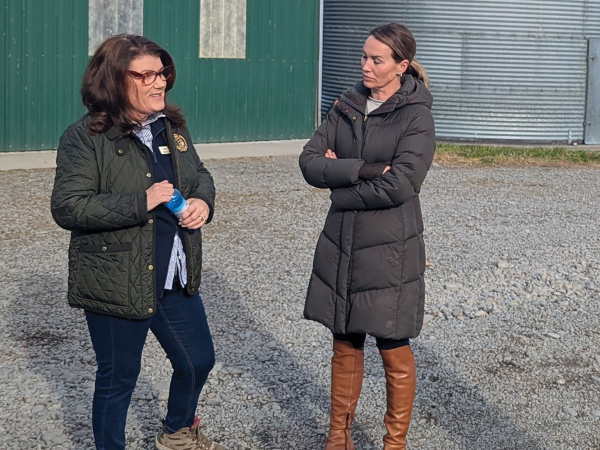 Associate Minister for ACC Nicola Grigg (right) and Safer Farms ambassador Lindy Nelson talk safety during an event on a Canterbury farm celebrating a big drop in farm-related ACC claims.
A huge reduction in ACC claims from on-farm accidents over the last five years is due to thousands of small, practical decisions being made in sheds, yards, paddocks and around kitchen tables across the country, says Safer Farms ambassador Lindy Nelson.
Claims are down from about 25,000 in 2020 to 16,666 last year.
Nelson says it shows that farmers, growers, contractors and rural teams are choosing safer ways of working because they know their land, their stock, their machinery and their people best.
"Farmers deserve real credit for this progress. They are the ones making the calls day by day, slowing down when the weather changes, setting jobs up properly, talking things through with staff and family and finding practical fixes that work in the real world. That is why the drop in claims is encouraging.
"However, no one in rural New Zealand will see it as job done. Too many farming families still know someone who has been hurt or worse."
The milestone was celebrated last week with a gathering on the Leeston farm of Federated Farmers health and safety spokesman David Birkett, attended by ACC associate minister Nicola Grigg and industry leaders including Dairy Holdings ex-CEO Colin Glass, PGG Wrightson CEO Stephen Guerin - both Safer Farms board members - and Federated Farmers President Colin Hurst.
A Wairarapa farmer, Nelson chaired Safer Farms from 2020 through to January 2026 and was instrumental in the formation of the Farm Without Harm strategy launched in 2023.
She believed Farm Without Harm was a global first in terms of industry-wide collaboration.
Asked how much of the reduction in ACC farm claims was due to the campaign, she said it was about visibility.
"And it's about communicating and giving [farmers] some tools and technologies. But it's their choice to make good decisions and take that knowledge and apply it, which is what we're celebrating today."
Nelson said that ACC funding of $11 million over five years, announced in early 2025, allowed Safer Farms to gear up the Farm Without Harm team, pick up some initiatives and "do the deep dive" into four high-harm areas identified as its targets.
These are: the psychosocial risks of mental health impacts and diminished wellbeing; vehicles and machinery accidents; livestock handling injuries; and exposure to agricultural chemicals and airborne hazards.
Nelson said they had focussed on vehicle harm in the last two years and had recently started work on livestock handling.
ACC Head of Injury Prevention Renee Graham said in a statement that the drop in claims was "really encouraging".
"It's difficult to pinpoint exactly why we're seeing this downward trend. However, there's a lot of great work being done by organisations like our partners Safer Farms, who are on the ground with our farming communities delivering targeted prevention programmes and are inspiring a safer farm culture."
Graham said there would always be risks in an industry that involves operating heavy machinery and handling livestock.
Common causes of injuries for farmers were from lifting, carrying and twisting, as well as falls.
"Being tired and rundown effects decision-making, so we encourage all farmers to stop and think before they get stuck in."
Federated Farmers has welcomed new rural policies released by ACT, saying they align closely with its own election priorities.
Federated Farmers is backing Feilding High School’s call to keep Agriculture and Horticultural Science as a standalone subject in Year 11.
Decades piloting planes has ensured vet and farmer David Hayes is focused on safety. So, after a serious accident while welding on farm, he is sharing his experience so others can learn from it.
National’s pledge to introduce 19 new national standards shows the party is serious about getting Wellington out of farming, Federated Farmers says.
Safer Farms is urging farmers to make sure everyone working on farm has safe, suitable footwear for the job.


Federated Farmers has welcomed new rural policies released by ACT, saying they align closely with its own election priorities.

Rural Contractors NZ says proposed changes to land transport rules for agricultural vehicles are a welcome response by the Government to out of date regulations which have seen members hit with huge fines.
Alliance is calling for final applications for its 2027 Graduate Programme, with applications closing on Sunday 25 October.
Decades piloting planes has ensured vet and farmer David Hayes is focused on safety. So, after a serious accident while welding on farm, he is sharing his experience so others can learn from it.
Canterbury milk processor, Synlait Milk has confirmed Leon Fung as its chief executive officer.
OPINION: Making it easier to collect rainwater and use it to grow crops and livestock is a no brainer.



OPINION: It seems Canterbury processor Synlait is still in the doldrums.
OPINION: Get offside with New Zealand First leader Winston Peters at your own peril.




