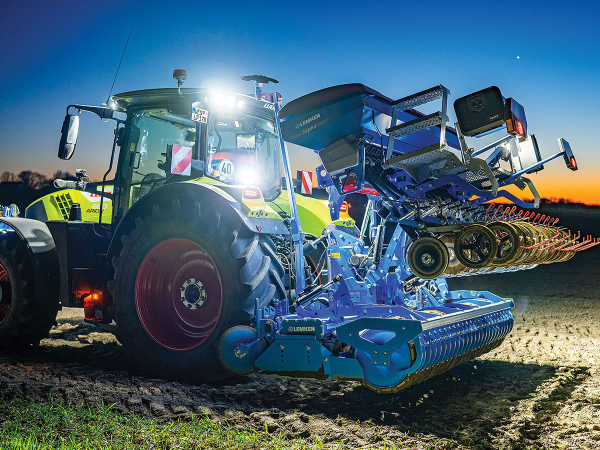
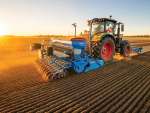
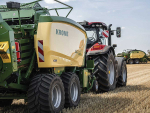
The new Lemken Saphir XMR mechanical seed drill has been introduced as the successor to the proven Saphir 10m with the manufacturer claiming new standards for precision, ease of use, and area coverage.
The XMR’s metering system, developed from the ground up, is built for ease of use, allowing the metering wheels to be removed individually without tools, making it easy to switch between different seed types, alongside cleaning and maintaining the machine.
Different seed wheels ensure that both fine and larger seeds are sown precisely and evenly, while as standard equipment, the system includes a double-sided electric drive with half-width section switch, meaning reducing overlap at headlands or while operating in irregularly shaped fields can help save seed and reduce costs.
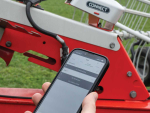
In addition to its precise metering, the Saphir XMR is configured for ease of use, with depth control adjusted via a central lever, while coulter pressure and sowing depth can be adjusted separately. A patented tramline control system is also designed for flexibility, allowing operators to select different tramline patterns and working widths. Meanwhile, the iQblue drill offers an ISOBUS-based operating concept with logical, clear access to all key machine functions.
To ensure reliable seed placement, the drill uses the tried-and-tested parallelogram-guided double disc coulter with pressure roller, to ensure consistent seeding depth and good soil contact even under varying soil conditions and at higher speeds.
In addition, coulter pressure can be easily adjusted to up to 45kg using the grid adjustment mechanism, with the drill available with 12.5- or 15-centimetre row spacings.
The Saphir XMR can be configured with 900, 1200, or 1500 litre tank capacities, and has a large opening, rigid, waterproof plastic lid, making filling with big bags or a front loader easy.
The MultiHub can be installed as an optional 200-litre auxiliary tank for micro-granules or catch crops.
The Saphir XMR can be mounted as a combination unit on the Zirkon EMR and Zirkon XMR power harrows, equipped for the first time with the optional 600-series roller, offering significantly reduced rolling resistance and improved reconsolidation, particularly on light soils.
During operation, the semi-mounted design sees hydraulic cylinders lift and swivel the seed drill forwards simultaneously, reducing the rear axle load and ensuring stable weight distribution – particularly important during road transport.
In other news, challenging market conditions in the agricultural machinery sector are behind Lemken’s decision to temporarily introduce short-time working between July and the end of the year at its Alpen site in Germany.
The site, which is also Lemken’s headquarters, employs around 1200 staff and produces approx. 15,000 ploughs, cultivators, compact disc harrows, power harrows and seedbed combinations annually.
www.lemken.com