
Labour Vows to Change Tact on How to Handle Freshwater Rules
A Labour-led Government won’t be bringing back the controversial freshwater rules of 2020.




 increase font size
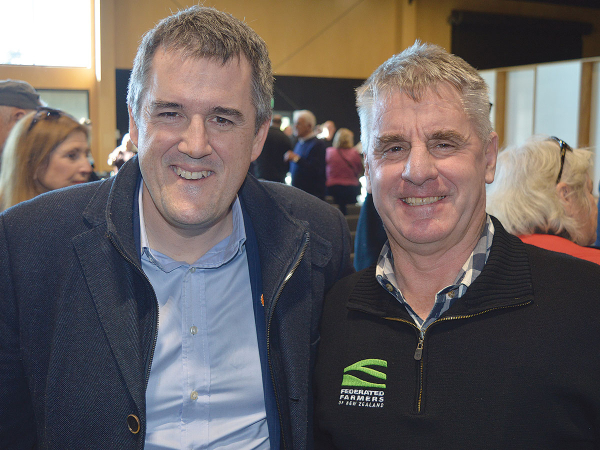 Resource Management Minister Chris Bishop and Federated Farmers president Colin Hurst at the farmer meeting in Waikato recently.
A pause on Waikato Regional Council's (WRC) plan change that sets new freshwater rules for farming could be announced in the coming weeks.
All three parties in the coalition government want WRC's Plan Change 1 (PC1) paused until the Resource Management Act is replaced with two new laws: the Planning Bill and the Natural Environment Bill.
A parliamentary select committee reports back on the Natural Environment Bill this week. Rural News understands a pause could be announced after the second reading of the bill in Parliament.
Associate Agriculture Minister Andrew Hoggard says his party wants fewer consents and fewer headaches for farmers.
"We want a much simplified way of doing things, not having farmers to duplicate farm plans at extra cost," he says.
Hoggard says PC1 is not something his party wants.
New Zealand First deputy leader Shane Jones wants PC1 "paused before it becomes a bureaucratic death sentenced for farmers and growers across the region".
"Plan Change 1 is a 14-year-old regulatory taniwha, dragged out of the swamp by the old RMA, and now threatening to strangle the very people who feed this country," says Jones.
"That is not environmental management. That is economic vandalism wearing a hi-vis vest and carrying a clipboard," Jones says.
More than 4,500 farms across the Waikato and Waipā catchments could be affected, with hundreds facing the prospect of needing resource consent simply to continue existing farming operations.
At a meeting organised by Federated Farmers this month, Resource Management Minister Chris Bishop and Agriculture Minister Todd McClay heard from frustrated farmers.
Waikato Federated Farmers meat and fibre group chair Reon Verry told the meeting that farmers aren't happy with the situation.
"A whole lot of farmers that need resource consents which may then become redundant under the replacement for the RMA.
"So, the thinking is that 30-40% of dry stock farms may need consents and 75% of dairy farmers are likely to need controlled activity consents."
Verry says there was huge frustration among farmers.
"A lot of confusion in how these rules are going to line up with the current reforms that are coming.
"There's a real misalignment or collusion between what we're seeing in PC1 and what we've heard."
Bishop told farmers that an "entirely new planning system" is coming, with different rules and a much more permissive and liberal approach.
"It will be easier to do things in this country once the new rules come in."
Bishop says they are thinking deeply and carefully about what to do with PC1.
He hinted that there was a cabinet process to go through and a collective decision was needed at cabinet level.
A WRC spokesperson says that they have not received any director from the Government.
"We are presently responding to the directions of the court," he told Rural News.
"Implementation of PC1 is staged over a five-year period to allow time for council and industry bodies to be able to better support farmers and growers and others in the catchment.
"The adjustments needed will depend on the farm and the associated risks of contaminant loss, with those who have already implemented a range of good management practices generally expected to need fewer adjustments."
A Labour-led Government won’t be bringing back the controversial freshwater rules of 2020.
Central Otago District Council (CODC) has voted against a plan to spread treated sewage sludge from Cromwell and Alexandra on farmland near Lauder, a decision Federated Farmers says reflects strong opposition from rural residents.
Federated Farmers has called on Central Otago District Council (CODC) to drop or vote down a plan to truck sludge from Alexandra and Cromwell to farmland near Lauder, warning it would compound an "outrageous" situation created by a separate council's decision weeks earlier.
Federated Farmers says new legislation replacing the Resource Management Act will cut red tape, unlock investment and help grow New Zealand's export-led economy, after the Planning Bill and Natural Environment Bill passed their third reading in Parliament yesterday.
Leading figures from the major political parties will be questioned on their primary sector policies at the Rural Issues Debate at Mystery Creek Events Centre, Hamilton, on 30 September.



Farmer-owned fertiliser company, Ballance Agri Nutrients is welcoming National’s plan to negotiate security agreements with key supplier countries to protect New Zealand-bound products from export restrictions and greater supply chain certainty.

Carrfields has announced the appointment of Stu Hall to the newly created role of chief operating officer, Carrfields Ltd, reflecting the continued growth of their agribusinesses and the need to ensure the company has the leadership capacity and support in place as it pursues the emerging opportunities ahead.
New Zealand's role is not to compete with Indian growers, according to NZ Apples and Pears.
The potato industry is celebrating the success of two rising stars - James Blair, the 2026 Young Grower of the Year and runner-up and innovation award winner, Amber Davy.
Twenty-eight emerging leaders from across the horticulture sector spent two days last month learning valuable skills and connecting with industry experts.
There are five entrants in this year’s Young Horticulturist of the Year, competing in a series of technical, practical, business and leadership challenges.





OPINION: The same mainstream media muppets that brought you Jacindamania in 2017 have been flat out pimping for the Opportunities…
OPINION: Your old mate reckons the atrocious way farmers in the UK are treated by their lords and masters in…




