
Pouarua Water Storage Scheme Gets Government Backing
The Government is backing work on a community-led water storage scheme that could irrigate up to 11,000 more hectares of the Poverty Bay flats, Agriculture Minister Todd McClay says.




 increase font size
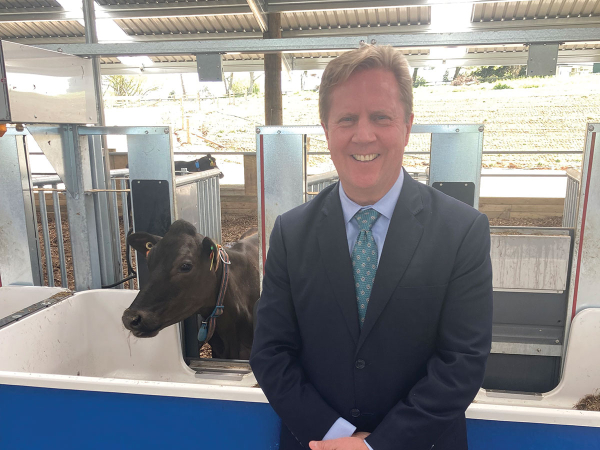 Trade Minister Todd McClay says global trade rules are more contested, and he doesn’t expect that to change anytime soon.
The stark realities of the world trade that New Zealand is having to face have been revealed by Trade Minister Todd McClay.
Speaking to the NZ Institute of International Affairs, he pointed out that the world we now trade in is harder and much more uncertain than it was five years ago.
He says trade rules are more contested, relationships more complex, disruptions more frequent and what's more, he doesn't expect that to change anytime soon.
"The major economies are really playing outside the rules with very sharp elbows. These shifts are the clearest signal yet of a broader global trend: we are moving from a world governed by shared rules to one increasingly shaped by power. For a small trading nation, that shift matters more than it does for many other countris," he says.
McClay says events in the past year have increased the pressure on NZ - in particular, the war in the Middle East and the closure of the Strait of Hormuz, which has made getting exports to that region harder and more expensive.
Disruption to the supply of oil to NZ has driven up costs right through the supply chain.
He says the situation remains fragile, and exporters are navigating challenges with sourcing key inputs, maintaining competitiveness in the face of rising production and distribution costs, and finding reliable routes to market.
"Even before that conflict, our exporters were already navigating a fundamentally changed approach to tariff policy from the United States. And the US is not the only one. Just ask our dairy exporters to Canada," he says.
McClay says for a small nation like NZ, rules-based trade has always mattered more to us than the larget economies who have far more leverage internationally.
He says Kiwis believe in fairness and the rules deliver that.
"It is worth remembering that despite everything, 72% of world trade still takes place under WTO rules. The system is battered, but it is not broken, and NZ has a clear national interest in saving as much of the multilateral furniture as possible," he says.
McClay admits that progress at a multilateral level is too slow for our exporters, which is why he says FTAs are vital and why the Government has invested heavily in these.
He says in 2025, 71% of NZ's exports were covered by 17 high quality FTAs and results from these are tangible.
"Since our EU FTA came into force two years ago, our exports there have grown by NZ $3 billion. And in the 18 months since our FTA with the UK took effect, our exports there grew by 13%," he says.
McClay adds that NZ exports to the UAE have seen record growth of 33% following that agreement's entry into effect and says the new FTA with India will produce further export growth and stability to our primary exports.
While there has been a strong focus on securing FTAs, McClay says NZ has been making progress on a number of olther key initiatives.
These include the CPTPP, the Digital Economy Partnership Agreement, a Green Economy Partnership and RCEP.
But one of the biggest and most insidious issues facing NZ trade is the raft of non-tariff trade barriers (NTBs) which currently affect $9 billion worth of our exports. These are rules randomly applied by importing countries which impede the flow of our exports to a country and reduce the return to NZ producers.
“Last year alone we resolved some of these to the tune of $600 million dollars, but there is clearly plenty more work to be done,” he says.
Looking to the future, McClay says the present challenges that NZ faces are not new and the hard work of the past must continue to be more creative, persistent, constructive and bring more energy and urgency to the task. He says it’s important for NZ to make itself known to the world, hence the emphasis on trade missions and an investment agency which establish strong political and business relationships.
The Government is backing work on a community-led water storage scheme that could irrigate up to 11,000 more hectares of the Poverty Bay flats, Agriculture Minister Todd McClay says.

A Labour-led Government won’t be bringing back the controversial freshwater rules of 2020.
OPINION: The United States wine market has changed forever, and companies cannot use same old playbook, said Erin Kirschenmann at the New Zealand Wine 2026 Wine Business Forum in August.
It was billed as a chance for all the political parties to woo the rural vote, but question marks hang over just how effective this was.
There's been widespread support from the primary sector for the Government's announcement on changes to freshwater farm plans that come under the Natural Environment Bill, which is now set to replace the existing RMA.



Fonterra Co-operative Group chief financial officer Andrew Murray has resigned to take up a role outside the dairy giant.
A major move is about to get underway to improve the quality and viability of dairy beef and cattle in NZ.
Veterinarians say changes to the code of welfare for dairy cattle provides a positive foundation for improved cattle welfare across the country.
Today, 15 October, is the International Day of Rural Women, which recognises rural women’s contribution to farming, communities and the environment.
Global dairy giant Lactalis has integrated its Australian operations with the Mainland Dairy consumer business it acquired from Fonterra earlier this year.
High country stations, mixed sheep and beef farms, Māori-owned farms, corporates and family operations are among the nine commercial farms taking part in the Livestock Innovation Farming Transformation programme, known as LIFT.



OPINION: It seems Canterbury processor Synlait is still in the doldrums.
OPINION: Get offside with New Zealand First leader Winston Peters at your own peril.




