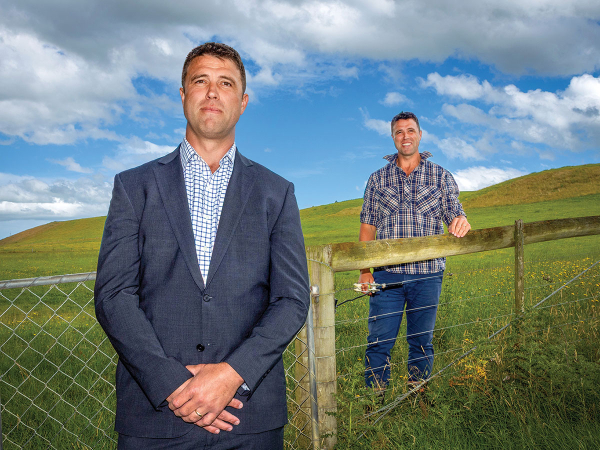
One day he might be in a boardroom, making calls on the agri strategy for New Zealand’s largest bank across the lower half of the South Island.
The next, he’s back on the family farm in Darfield, putting up a break fence while reflecting on the same pressures his customers are facing.
Reed is ANZ’s provincial southern head of business and agri, overseeing the bank’s business and farm lending across the lower South Island, while also carrying responsibility for helping to shape ANZ’s agri strategy and direction.
His family has been farming in Darfield for more than 125 years.
Today, the operation is in the middle of converting from a dairy‑support & arable operation to dairy, a process that brings opportunity, cost, risk and no shortage of uncertainty.
Having ownership in the farm means every decision affects him personally.
Growing up in the 1980s and early 1990s, Reed saw first-hand how brutal things could become when the economy turned against farmers.
“When the bank manager used to ring, it felt like an anxious time for the family, and I could see that from quite a young age,” Reed said.
Those memories stuck, shaping how Reed approaches banking today.
“There’s nothing like a few sleepless nights of your own when you’re under pressure, be it financial, land use change, or succession, to put into perspective what some customers might be feeling,” he says.
After finishing school, Reed studied Finance and Economics at Lincoln University before spending time working and playing rugby overseas.
He knew he was good with numbers but had no clear plan for where that would take him.
“I didn’t have a clue what I wanted to do,” he says. “I had no idea I’d end up in banking.”
In hindsight, banking proved a natural fit, especially once he stepped into ownership of the family farming business.
Living and breathing farming alongside his banking career, Reed believes, has fundamentally changed how he does his job.
“It’s made me a better banker,” he says.
“I put myself in the customer’s shoes and think, if I was in this situation, how would I want to be treated or spoken to?”
For Reed, farming is deeply intertwined with family, and identity.
“You’re dealing with people. You’re dealing with homes. You are often dealing with a huge amount of history - things that can be deeply emotional,” he says.
“At times there’s a perception that banks are only there in the good times, and yes, it’s easy to be supportive when commodity prices are strong.
“But the farming sector feels volatility more acutely than most. You can see milk, beef or sheep prices drop by 20 or 30 per cent within a year. You also can have a huge degree of variability in feed or crop yields based on what weather is served up in a season.
“What customers really want is a banker who understands what they’re going through - someone who can be there for them through a tough period, take a longer-term view, and help them come out the other side.”
That understanding, Reed believes, is what separates good banking from average banking.
"Without really understanding the customers and the industry well, it can be hard to see past the numbers on a page," he says.
With farm costs top of mind for many businesses, he says some of the most rewarding work since he joined the bank in 2024 has involved finding solutions for farmers wanting to make their operations more resilient.
"When prices are good, the best operators use that window to strengthen their balance sheets, diversify, and invest in things that add value long term," he says.
"They think about succession, 10 or 20 years out, and focus on the things they can control rather than the things they can't."
Change Is The Only Constant
Looking ahead, Reed says change remains the only constant for New Zealand farmers, but he's confident the sector is well placed to adapt.
"I think we've got some of the most progressive farming mindsets in the world," he says.
"New Zealand farmers are very good at adapting and adopting new technology."
He points to growing interest in on-farm renewable energy, particularly solar, as one way farmers can build resilience against rising costs and supply shocks.
Succession, too, remains front of mind for many farming families.
Back on the farm, Reed tries not to lose sight of that long-term perspective.
"I had an old colleague who, whenever I asked how he was, would always say, 'well, it's another day above ground isn't it?'," he says.
"At first I laughed, but over time I realised there was a lot of wisdom in that.
"Even when things are hard, it's about remembering what's important, and appreciating the opportunity we've been given."
For a banker who's also a farmer, it's a mindset that carries weight on both sides of the fence.