New Research Shows Good Farming Practices Reducing Nutrient Losses on Dairy Farms
Analysis of decades of research has revealed the good farming pracrtice plays a critical role in reducing nutrient losses to improve freshwater outcomes.




 increase font size
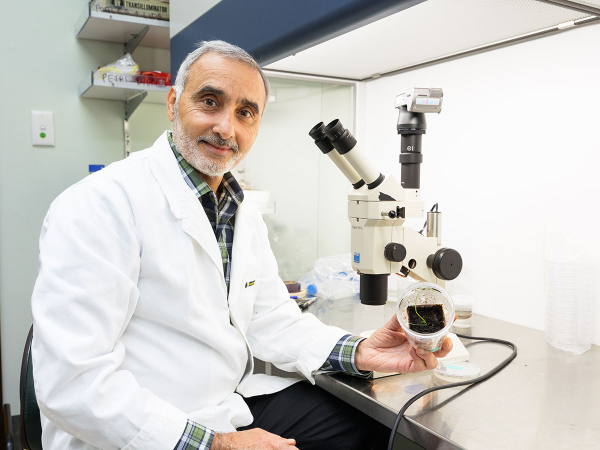 Dr Wajid Hussain
Scientists from the Bioeconomy Science Institute Maiangi Taiao has achieved a successful cocksfoot-ryegrass cross capable of producing fertile seed, a world-first.
Hybrid plants are now growing in a Palmerston North greenhouse - the first time this notoriously difficult pairing had produced viable seed, despite decades of international effort.
Researchers say the result won’t change pastures overnight, but it could eventually open new pathways to grasses that are more resilient, more nutritious, and better suited to a changing climate.
Cocksfoot and ryegrass are two foundational species in New Zealand agriculture. Cocksfoot offers drought tolerance and persistence; ryegrass provides high feed quality and ease of establishment. For years, breeders have tried to combine their strengths, but the two species are so distantly related that traditional hybridisation repeatedly failed.
Although Japanese and German researchers in the 1990s did manage to produce some plants, nearly 4000 previous attempts resulted in hybrids that were weak, infertile, and unable to produce viable seed. The prevailing scientific view became that the barrier was simply too high to overcome without a much deeper understanding of the biology involved.
That deeper understanding came from Bioeconomy Science Institute scientist, Dr Wajid Hussain, who drew on years of experience working on complex clover crosses. By applying new strategies to navigate the long-standing biological barriers, the team achieved what earlier generations of scientists could not.
The breakthrough came late last year.
“This has been an incredibly risky and technically challenging process but immensely satisfying for the large number of people involved,” says Hussain.
“We now have enough of the hybrids to show the method works and to open the door to the next wave of scientific exploration.”
The “neonatal care unit” for plants
The key to success was a specialised technique known as embryo rescue.
When cocksfoot and ryegrass are crossed, an embryo may form, but the seed’s endosperm - the natural food source - does not. Without that nourishment, the embryo cannot survive.
Before that could happen, the team delicately removed the tiny embryo and transferred it onto an artificial nutrient medium, effectively placing it into a controlled, plant scale equivalent of neonatal intensive care. With this support, the embryo developed into a viable plant and, remarkably, later produced fertile seed.
Why this matters – eventually - for farmers
Researchers are quick to temper expectations.
These plants are a proof of concept, not a commercial product. The hybrid’s traits are not yet optimised for paddock conditions, and further study is needed to understand how best to harness the advantages of combining two species that have never successfully hybridised in nature.
Work will now shift to stabilising fertility, assessing agronomic traits, and developing later generation hybrids, including a planned three-species grass hybrid.
If successful, the research could produce pre breeding material for commercial seed companies in the future. But scientists emphasise that the pathway from breakthrough to farm gate will take time.
Bioeconomy Science Institute Plant Genetics Science Team Leader, Dr Marty Faville, explains: “Good science, as they say, requires careful validation, multiple generations of refinement, and ongoing collaboration with farmers and breeders. But this is an exciting development and a career highlight for many in the team.”
A breakthrough worth watching
Even at this early stage, the achievement is generating interest from pastoral farmers and international research groups. Future development will be supported by Grasslanz Technology, which will explore commercial pathways to help ensure the science ultimately delivers benefits on farm.
The work will also be submitted for publication in a scientific journal.
For agriculture, any advance with the potential to combine improved feed quality and stronger tolerance to climatic stress is worth attention.
For science, this breakthrough opens a door long believed to be locked.
Analysis of decades of research has revealed the good farming pracrtice plays a critical role in reducing nutrient losses to improve freshwater outcomes.

Could New Zealand use its unproductive land to help solve possible fuel insecurity in New Zealand? Scientists say yes.
Bark and ambrosia beetles could play an unexpected role in New Zealand's ecosystem, acting as tiny taxis for fungi.
One of New Zealand’s longest-running pasture growth monitoring projects will continue, even as its long-time champion steps away after more than five decades of involvement.
A New Zealand-first native tree study has highlighted the Bioeconomy Science Institute's position as a forestry research leader.


South of the central Hawke’s Bay town of Waipukurau is Taniwha Station – a highly successful 550ha bull beef farming operation.
Beef + Lamb NZ funded research has shown that some simple changes to pasture management could help farmers make better use of rainfall and build resilience before dry conditions hit.
OPINION: There could hardly be a more appropriate theme for a conference than the one chosen by the red meat sector - Navigating Volatility.
When Northland leather worker Vernon Suckling started making horse saddles 50 years ago, quad bikes and side-by-side vehicles were unheard of.
Alliance Group has confirmed that eligible farmer-shareholders who supply and continue to back the business will receive up to $20 million later this year, following the strategic investment partnership with Dawn Meats.
With a general election under five weeks away, Rural News is asking major political parties about their policies and positions on key issues facing the primary sector. We will run their responses to each question over the next four weeks. The ACT Party and the Greens didn't respond in time.





OPINION: The same mainstream media muppets that brought you Jacindamania in 2017 have been flat out pimping for the Opportunities…
OPINION: Your old mate reckons the atrocious way farmers in the UK are treated by their lords and masters in…




