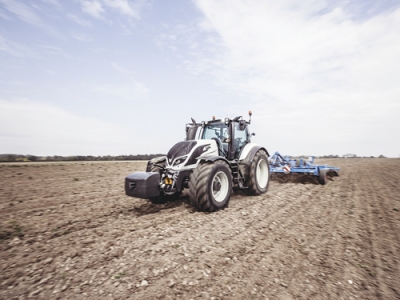
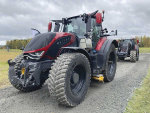
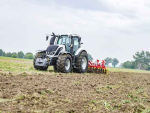
The fourth generation of the Valtra T Series offers models with 155-250hp and up to 1000Nm torque, a large amount of power to take on demanding tasks.
They are available with two transmission variants – Versu and Direct.
The Versu models have the maker’s AutoTraction automatic clutch function for its powershift transmission, which allows shifts automatically by monitoring travel speeds, unlike competitor systems that look at engine speed. Additional features such as hill-hold and hydraulic assistant aid the driver with transport and frontloader operation. The Powershift operates with five steps in four gear ranges, plus 10 speeds in the creeper ranges, giving a total of 30 forward and 30 reverse speeds.
The Direct transmission, built in-house by Valtra, offers three driving modes. The default is pedal mode (automatic): the driver sets the target speed with the drive pedal. In lever mode (automatic) the driver sets the target speed by the drive lever. In manual mode the driver can set separately the engine revs and manage the driving speed independently with the drive lever.
T Series models are powered by 6.6L or 7.4L AGCO Power engines. Exhaust emissions are minimised by a Tier 4 Final SCR system. The SCR system and optimised turbo and engine package results in excellent fuel efficiency and eliminates the need for an exhaust gas recirculation system or diesel particulate filter.
The T174 model comes standard with Valtra’s EcoPower feature. When the driver presses the eco button the nominal engine speed drops to 1800rpm while torque increases. This reduces fuel consumption by about 10%, lowers the noise level and extends engine life. In addition, the Sigma Power feature, standard on all models, increases engine output by 15hp when the PTO is under sufficient load. The transport boost function in turn raises an extra 15hp in the C and D ranges.
The most striking feature of the fourth generation T Series is its new cab – stylish, spacious and quiet. Pillars that curve outwards maximise interior space for the driver and keep the external dimensions compact. The cab is now 20cm wider by the driver’s seat than the previous generation, for plenty of room.
Electrically heated front and rear screens, a front windscreen wiper sweeping 270 degrees, factory-fitted parking cameras, LED working and rear lights, and six square metres of glass combine to offer unsurpassed visibility if optioned. Also, the optional roof window helps when operating a frontloader.
Other features include stereo with subwoofer, cool box, TwinTrac reverse-drive system that can be adjusted laterally and a factory-fitted, fuel-powered, phone-operated auxiliary heater.
www.valtra.com.au