UK Politician Alistair Carmichael Praises "Positive Spirit" of NZ Farmers
A leading British farming politician says he's impressed with the positive attitude of New Zealand farmers that he met during his recent trip here.




 increase font size
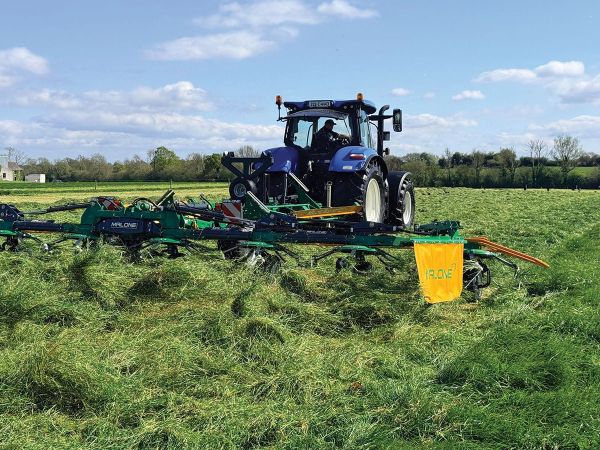 The Tedd-Air 1120-T is a robust unit with standout features.
Building on an increasing reputation for robust, productive machinery for grassland conservation, Malone has a duo of machines on display at Mystery Creek that should be ideal for the New Zealand market.
Based in County Mayo in the west of Ireland, Malone Farm Machinery started out in 1999, initially building simple pieces of farm machinery before moving into the grassland arena with mowers, tedders and swathers.
The business now exports to many markets around the globe.
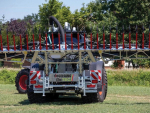
Used to dealing with heavy, damp crops in the home market, the Tedd-Air 1120-T is a robust unit with standout features such as hydraulic accumulators for machine stabilisation, alongside maintenance-free, liquid grease filled gearboxes.
Based around a heavy-duty main frame – with twin rear wheels and a swivelling lower link connection – the lateral frames fold forwards to keep transport width at 3 metres.
Eight heavy-duty rotors are supported on individual wheels/tyres.
Offering 3-position height adjustment to ensure the crop is lifted without soil ingress, extensive ground adaption across the full 11.2 metre (37 feet) working width allows good output, with the hydraulic accumulators making sure the machine tracks properly behind the tractor.
Each 1.6m diameter rotor is equipped with seven tines, incorporating a hooked end design to lift wet, heavy grass and invert the crop to bring wetter material to the surface for prompt drying.
The rotors are angled forwards to help lift the crop and spread material evenly across the full working width in a lump-free carpet.
Standard equipment includes a foldable headland curtain to separate tedded and untedded grass and to keep crop away from the boundary fence line. In addition, a positive locking system offers safe road transport between sites, complemented by a lighting kit and a spare wheel for unexpected problems.
Once crops have been tedded and lost sufficient moisture, a swather or rake is required to set up a swath for the following operation, such as forage harvesting or baling.
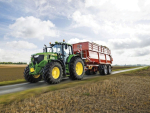
The Proline 610, twin-rotor swather is again built around a heavy-section, central spine, connected to the tractor by a lower link, swivel-hitch, with a steered rear axle equipped with flotation tyres, ensuring the machine tracks the prime mover and is able to make tight headland turns.
Each 2.8m diameter rotor carries 11-tine arms, each fitted with 4-double tines that gently lift the crop to form a centrally delivered, flat-topped, box-profiled swath, adjustable between 1.3 and 1.7 metres to suit height adjustment to avoid soil contamination, carried on 4-wheel under-carriages, while also incorporating an adjustable cam track to adjust delivery point and swath width.
Standard equipment includes an electrical control box to lift and lower the rotors, as a pair, or individually to work “short ground” or tight corners, alongside the lighting kit and a spare wheel and tyre assembly.
Visit www.gaz.co.nz
A leading British farming politician says he's impressed with the positive attitude of New Zealand farmers that he met during his recent trip here.

A new digital assistant is now helping Ballance Agri-Nutrients farmers speed up nutrient information and ordering.
OPINION: At Fieldays this year, one theme kept surfacing across the sector: global shocks are no longer something that happens “over there”. They are now translating quickly into local, farm-level impacts through increasingly complex and connected channels.
As the dust settles after Fieldays, we're once again reminded of the sheer volume of technology now available to New Zealand dairy farmers.
Last month's National Fieldays was an important event for Canadian manufacturer Can-Am, as it unveiled its first electric ATV, the Outlander, adding extra option to the new Defender HD11 and Defender MAX HD11 line-up.


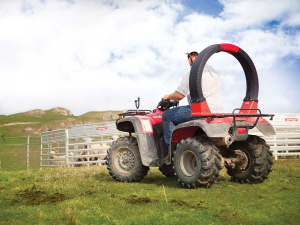
When Northland leather worker Vernon Suckling started making horse saddles 50 years ago, quad bikes and side-by-side vehicles were unheard of.
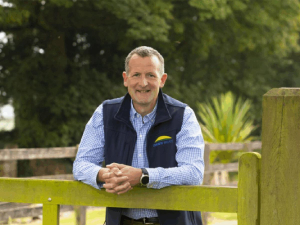
Alliance Group has confirmed that eligible farmer-shareholders who supply and continue to back the business will receive up to $20 million later this year, following the strategic investment partnership with Dawn Meats.
With a general election under five weeks away, Rural News is asking major political parties about their policies and positions on key issues facing the primary sector. We will run their responses to each question over the next four weeks. The ACT Party and the Greens didn't respond in time.
The red meat sector is in great heart.
Dr Scott Champion, Foundation for Arable Research chief executive, says that everyone in the supply chain had a role to play in driving the sector's long-term success.
Entries opened on Monday, 5 October 2026 for the 2027 New Zealand Dairy Industry Awards (NZDIA), which organisers describe as the nation's biggest celebration of excellence in the dairy sector.
OPINION: It seems Canterbury processor Synlait is still in the doldrums.
OPINION: Get offside with New Zealand First leader Winston Peters at your own peril.