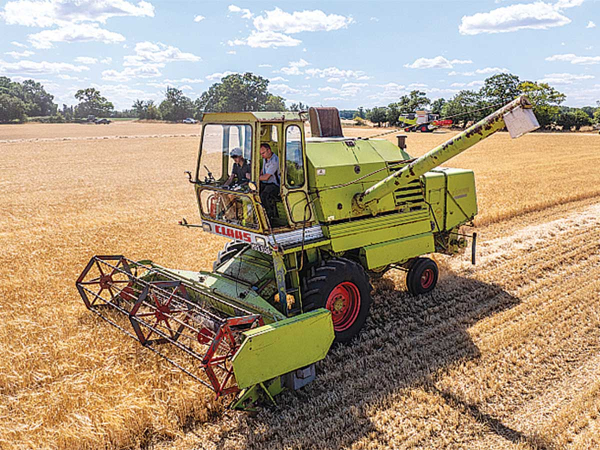
Fifty Eight years ago, on the 16th of August 1968, August Claas, the founder of the harvesting company and father of Helmut Claas, personally presented a Claas Senator combine harvester to Scottish farmer John Steven.
The presentation represented a milestone for the German company, being the 200,000th Claas combine built. The company had doubled its combine production only six years after celebrating the 100,000th Claas combine in 1962, cementing its position amongst the world’s premier combine manufacturers.
Following decades of reliable service in Scotland, the veteran machine returned to the Claas UK headquarters in Saxham, Suffolk in 2025, where the machine was brought back to life by an enthusiastic service team, helped with parts support from the Claas World Parts centre at Hamm. Restoring the machine to full working order, the team were careful to preserve its patina as a nod to the battle scars it suffered during its decades of service.
Claas says the Senator was more than just another new combine model, as alongside its modern styling, it offered a new corporate identity and the introduction of the iconic Seed Green livery.
In July 2026, the combine showed it had lost none of its capacity for hard work, heading into a wheat crop in Suffolk and harvesting 20 tonnes of wheat in around five hours.
Later in the month, at Honey Hill Farm at Little Saxham, behind the Claas UK headquarters, three generations of Claas combines worked side by side in the same paddock, with the Senator joined by a 1953 Claas SF and a modern Trion 720. The event showcased the progress of harvesting efficiency with the SF harvesting around four tonnes per hour and the Trion delivering ten times that capacity at around 40 tonnes per hour.
Interestingly, Honey Hill Farm is still farmed by the Mann family, where back in the 1930s it served as the original base when Bill Mann first began importing Claas machinery, prior to moving to the extensive current Saxham site.