Mixer makes feeding easy
Coolbreene Trust near Taupo is a large-scale dairy operation farming 1150ha, including run-off blocks, within a 10km radius of its home base.




 increase font size
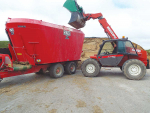
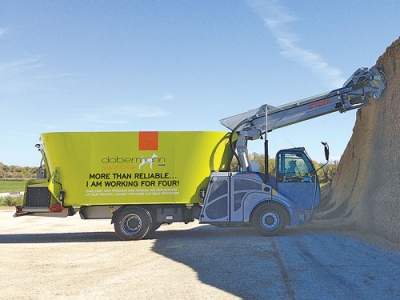 Storti’s self-propelled, self-loading mixer wagon.
One of the more interesting first-time exhibitors at National Fieldays was Storti, from Verona, NE Italy, showing a self-propelled, self-loading mixer wagon. This large machine was catching the eye of large scale dairy farmers.
Dating back to 1956, this company has extensive knowledge of the total mixed ration (TMR) market, evidenced by its range of trailed and self-propelled machines from 8-33m3 with vertical or horizontal mixing.
Most types of machine are also capable of self-loading, with a hydraulically driven cutter head on a loader arm mounted on the rear or front of the machine in the case of the self-propelled units. This has the major advantage of not needing a dedicated loader tractor, or in the worst case having to unhook the mixer wagon, load up, then re-connect to carry out a mix, which is very time consuming.
Storti marketing manager Ignacio Nunez mentioned standout features of the Doberman model on display: high efficiency rotor for a homogenous mix and low power consumption, bi-directional loading arm to suit all types of material being loaded, and heavy ladder construction chassis.
He also pointed out options such as the in-built weight system and the single lever control of the whole unit.
Nunez also announced the recent signing of a distribution agreement for New Zealand with Robertson Manufacturing, Canterbury, well known for their bale and silage feeders.
Robertson sales manager Tyronne Campbell commented, “The addition of Storti to our product offering allows us to cover the whole spectrum of animal feeding, and the decision to join forces with Storti is based on their worldwide reputation for experience in the TMR field.”
Robertson plans countrywide demonstrations of the Doberman self-propelled machine.
Tel. 03 303 7228
Coolbreene Trust near Taupo is a large-scale dairy operation farming 1150ha, including run-off blocks, within a 10km radius of its home base.
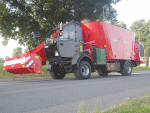
A self-propelled, twin vertical auger mixer wagon from KUHN dubbed the SPW Intense has been designed with nutritional considerations in mind.
Manufacturers of total mixed ration (TMR) mixers should stop claiming their machines have “better steel, bigger tyres and brighter lights” than competitors’ machines.
New from Irish manufacturer Keenan is a self-propelled diet feeder/mixer built with its Italian partner Storti.
A recently introduced premium range of goat feeding equipment from Stallion Plastics should hit the shelves in time for this year’s kid rearing season.


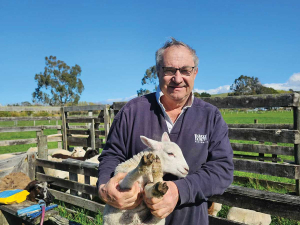
Decades piloting planes has ensured vet and farmer David Hayes is focused on safety. So, after a serious accident while welding on farm, he is sharing his experience so others can learn from it.

Canterbury milk processor, Synlait Milk has confirmed Leon Fung as its chief executive officer.
OPINION: Making it easier to collect rainwater and use it to grow crops and livestock is a no brainer.
As part of its Election 2026 coverage, Rural News asked political parties how they would help pull the arable sector out of the doldrums. Here's what they said:
Farmers are being encouraged to rethink how they manage waste on farm with the launch of ruralwastesorted.co.nz, a new website bringing together practical tips, real farmer experiences and resources.
New Zealand Winegrowers (NZW) is celebrating the India-New Zealand Free Trade Agreement (FTA) coming into force today, bringing New Zealand wine improved access to one of the world’s fastest-growing economies.

OPINION: It seems Canterbury processor Synlait is still in the doldrums.
OPINION: Get offside with New Zealand First leader Winston Peters at your own peril.