Kverneland upgrades baler, sets wrapping record
The Kverneland Group has announced several upgrades to its round baler ranges for 2025, much of it centred around automation, as well as the ability to wrap bales with film rather than net.




 increase font size
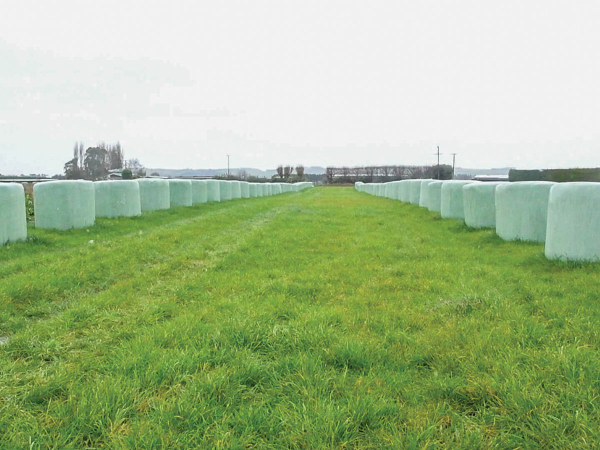 The concept of mechanically wrapping grass, emerged from Australia.
Machinery and Products editor Mark Daniel takes a look at the history of bale wrapping.
Wrapping baled preserves forage quality, but its evolution over close to 50 years has seen the development of practical solutions to solve problems that arose.
In the late 1970s, Lloyd Forster, a hill farmer from Northumberland, UK, was keen to look for a new solution for storing winter feed, as the topography of his farm and continual wet conditions, made hay making unfeasible.
At this time, the concept of using plastic bags to conserve wilted grass was becoming more common, addressing the problem of air ingress into the conserved material. The method offered flexibility and the option to store more feed for the winter months.
Bags were tied at the opening to keep them air-tight and allow the fermentation process to begin. While the process offered benefits, silage bagging was very labour intensive, while levels of moulds and spoilage were also fairly high, as the bags were generally inconsistent in quality, so far from perfect at keeping air out.
The concept of mechanically wrapping grass, emerged from Australia, where industrial plastic films were being used to wrap paper for the newspaper industry. Forster visited Australia and met with Ken Williamson, where the duo recognised the potential to use similar wrapping technology for grass, given that the newsprint reels were a similar size to the grass being conserved in bags.
Approaches to potential manufacturers, saw an Australian company create the first "balewrapper" design, which was imported into the UK. It proved popular, so the duo looked to develop the concept further, eventually selling the rights to Underhaug (part of the Kverneland group), who manufactured a new bale wrapper, capable of applying 500mm rolls of plastic film and marketed Volac International Limited.
At the same time, Forster approached several firms to manufacture a suitable plastic film to use with the bale wrapper. Bonar Polythene Films developed the first multi-layer blown silage film, under the Silotite brand.
By the early 1990s, bale weights had nearly doubled, while the introduction of net wrap to bind the bales made the process faster. This was achieved by removing the need to wait for 14 rotations to bind with string, as net wrap could be applied in three rotations.
The early 1990s also brought developments, such as 750mm rolls of film, which increased the speed of wrapping, and the introduction of square bales. This began with retrofitting kits to the Kverneland round bale wrappers, before a purpose-built square wrapper, with satellite wrapping arms, was introduced.
Later in the decade, following on from wrappers towed by the baler, the launch of combi-balers, resulted in a machine that could form and wrap the bale in a self-contained unit. By the 2000s, mini-wrappers were introduced for the equine market, wrapping small square haylage bales with 250mm and 360mm stretch film.
By the turn of the decade, the idea of binding the bale with film rather than net started to gain traction. Balers could be retrofitted with film binding kits, until eventually the leading manufacturers provided "film on film" balers from the factory that today is offered by almost all OEMs and considered the gold standard for silage production.
The Kverneland Group has announced several upgrades to its round baler ranges for 2025, much of it centred around automation, as well as the ability to wrap bales with film rather than net.
While baler-wrapper combinations have become the backbone of baled silage production, one machine stands out from the rest in the layout of the machine.
While round or large square bales have the dominant shares in the rural landscape, small square bales still play an important part, especially in the equine sector, but also where the large packages are not easily managed.
While the task of moving wrapped bales in New Zealand normally falls to trucks of flat bed trailers, in Europe, probably due to very strict secure load regulations, many trailer manufacturers are now offering more specialised trailers with hydraulically clamped side bars to keep load secure.
An American lucerne moistening system could help New Zealand farmers and contractors deal with drought during hay baling.



The avocado sector is entering the new season with a larger crop and positive market opportunities.
New Zealand growers have always adapted to changing conditions, but one challenge is steadily gaining ground across the horticulture sector: resistance.
Blueberries have the potential to become a major horticultural export, earning up to $150 million within the next three to five years.
Twenty five secondary school students from around New Zealand recently completed a three day residential programme designed to explore career opportunities across the food and fibre production supply chain.
Conversions of sheep and beef farms to forestry have slowed, however new research from Beef + Lamb New Zealand (B+LNZ) suggests land of value for food production remains at risk.
OPINION: A simpler, clearer, more effective Recognised Seasonal Employer (RSE) scheme.

OPINION: The Irish dairy sector is facing a new dilemma - maintaining year-round fresh milk supplies.
OPINION: Could beef cows play an increasingly important role in improving profitability and resilience on hill country farms?