While the task of moving wrapped bales in New Zealand normally falls to trucks of flat bed trailers, in Europe, probably due to very strict secure load regulations, many trailer manufacturers are now offering more specialised trailers with hydraulically clamped side bars to keep load secure.
Those looking for greater daily outputs and greater load security are starting to see even more dedicated solutions.
Irish company SAMCO, regular visitors to the Irish Pavilion at National Fieldays and well known for their machines for sowing maize under plastic, have recently released details of the new CTS1600 Bale Chaser.
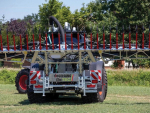
Said to enable one operator to load 16 netted or wrapped bales, without the need for a loader, in around eight minutes, a hydraulically actuated “squeezer” grabs, lifts and rotates the bales up onto the trailer. Designed to “load” itself automatically, the machine places two bales side by side and two bales high, before the “stack” is moved rearwards along the trailer body, using rollers.
Once loaded, the 16 bales are held securely by caged sides that squeeze inwards to secure the load, working in combination with gripping bars along the upper edge and the rear, to keep the load safe during transport.
Using a Danfoss load sensing hydraulic system to control the main functions, eight bales (four stacks of two bales) can be unloaded simultaneously, before the trailers needs to move forwards to discharge the remaining eight bales.
With an overall length of 7.3 metres, the chaser is fitted with tandem, air-braked ADR axles, with a range of options including oversize tyre and a steering axle set-up.