
NZ Apples Head to India: Apple Action Plan Gets a Leader
A seasoned horticulturist has been appointed to deliver the Apple Action Plan, a key initiative of the India-New Zealand Free Trade Agreement.




 increase font size
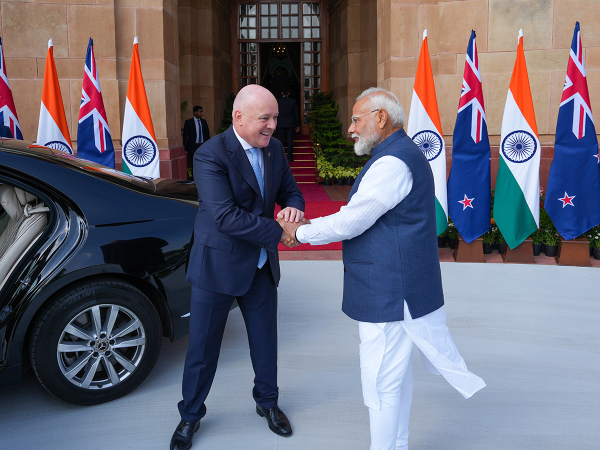 New Zealand Prime Minister Christopher Luxon and Indian Prime Minister Narendra Modi.
With the New Zealand/India Free Trade Agreement (FTA) dominating political debate here, India Prime Minister Narendra Modi will be visiting New Zealand next week.
The short visit - Modi arrives Friday July 10 and departs the following day- is the first to New Zealand by an Indian Prime Minister in 40 years.
Prime Minister Christopher Luxon says Modi’s visit is historic.
Luxon says India is one of the world’s largest and fastest-growing economies, and a country of enormous importance to New Zealand’s prosperity.
“We are taking the two countries’ relationship to the next level with our New Zealand-India Free Trade Agreement, signed in April, which will deliver more jobs, higher exports and stronger economic growth for New Zealand.
“It will reduce or eliminate tariffs on 95% of New Zealand’s exports to India once fully implemented. From day one, 5% of our exports will be tariff-free.”
The agriculture sector will be a big beneficiary of the FTA.
There’s immediate tariff elimination on sheep meat, wool, coal and over 95% of forestry and wood exports.
For the apple sector, there’s 50% tariff cut for large quota of apples – nearly double recent average exports.
Duty-free access for kiwifruit within a quota almost four times recent average exports, and tariff halved for exports outside of quota.
There is duty-free access for cherries, avocados, persimmons and blueberries, over 10 years.
Tariffs on wine are reduced from 150% to either 25 or 50% (depending on the value of the wine) over 10 years plus a Most Favoured Nation (MFN) commitment.
Tariffs on manuka honey are cut from 66% to 16.5% over five years.
The dairy sector, however, has failed to secure big gains, like exporting key NZ dairy products to India. The FTA allows duty-free access for dairy and other food ingredients for re-export from day one.
There is also duty-free access for bulk infant formula and other high-value dairy preparations over seven years.
National’s Coalition partner, New Zealand First has been critical of the FTA. Leader Winston Peters claims the FTA makes concessions for Indian migrants.
His deputy Shane Jones ruffled feathers, when on an online video, he likened the agreement to a "butter chicken tsunami" coming to New Zealand, implying a possible influx of Indian immigrants.
But Luxon says the FTA will unlock new opportunities to grow NZ goods and services exports into a market of 1.4 billion people and contribute to achieving the Government’s goal of building the future by doubling the value of exports by 2034.
Modi’s visit reflects the growing momentum in the New Zealand-India relationship. Discussions between the leaders will include trade and investment, maritime security, education, technology, tourism, sport, and global issues.
“This visit is about celebrating a winning partnership between New Zealand and India - one that delivers for our people and supports greater prosperity and security for both our countries. I look forward to welcoming Prime Minister Modi to New Zealand.”
A seasoned horticulturist has been appointed to deliver the Apple Action Plan, a key initiative of the India-New Zealand Free Trade Agreement.

National’s much-touted free trade deal with India featured in the Rural Issues Debate at Mystery Creek, Hamilton on Wednesday night.
OPINION: In politics, credibility is and should be big. It must surely rank higher than charisma, which is quite trite and superficial. Yet, voters nowadays are often wooed and influenced by how someone looks or talks at a superficial level. TV plays a huge role in this.
I think it's going to greatly weaken National at the election. That's the view of a former senior National MP on the recent attempted coup against Prime Minister Christopher Luxon.
PM Chris Luxon can't seem to buy a trick when it comes to the polls, particularly for his own approval rating as preferred Prime Minister.



National’s pledge to introduce 19 new national standards shows the party is serious about getting Wellington out of farming, Federated Farmers says.
The National Party’s policies to make it easier to grow fresh vegetables, secure reliable water and energy and simplify farm planning are practical changes that will give growers the confidence to invest, according to Horticulture New Zealand (HortNZ).
Fonterra Co-operative Group chief financial officer Andrew Murray has resigned to take up a role outside the dairy giant.
A major move is about to get underway to improve the quality and viability of dairy beef and cattle in NZ.
Veterinarians say changes to the code of welfare for dairy cattle provides a positive foundation for improved cattle welfare across the country.
Today, 15 October, is the International Day of Rural Women, which recognises rural women’s contribution to farming, communities and the environment.





OPINION: The same mainstream media muppets that brought you Jacindamania in 2017 have been flat out pimping for the Opportunities…
OPINION: Your old mate reckons the atrocious way farmers in the UK are treated by their lords and masters in…




