India FTA Removes 33% Tariff on NZ Sheepmeat
New Zealand’s red meat sector has welcomed the India-New Zealand Free Trade Agreement taking effect, which removes India’s 33% tariff on New Zealand sheepmeat.




 increase font size
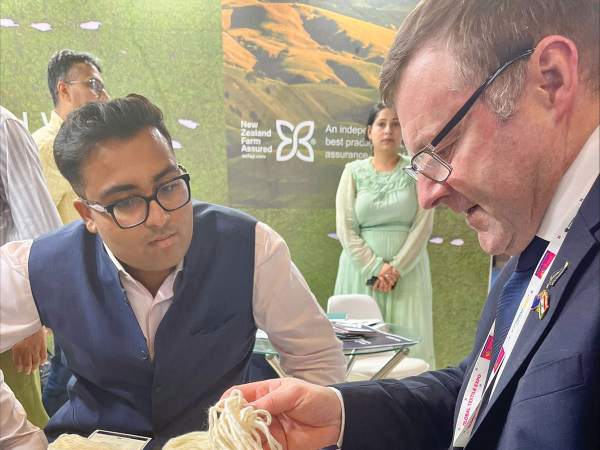 Associate Agriculture Minister Mark Patterson discusses yarn spun from NZ wool with Mohit Sipani at a textile expo in India last month.
Just a matter of hours after Indian Prime Minister Narendra Modi's historic trip to New Zealand, the political doors in India swung wide open for Associate Minister of Agriculture, Mark Patterson, who was there to help promote our high-quality coarse wool.
He was attending the mega Bharat Textile Expo in New Delhi, which has 3500 stands and attracts more than a million visitors over four days, supporting a NZ delegation to promote our quality coarse wool.
India is the second largest importer of our wool - last year it took 17,000 tonnes worth more than $79 million. China is the largest importer of our wool wool.
Patterson says, since the Wool Board disbanded many years ago, little engagement there's been with India has been mainly broker-driven and transactional. He says when a NZ wool delegation attended the Bharat Textile Expo last year, they were pleasantly surprised.
"It turns out NZ wool is held in very high regard and there is a real interest in what we are doing in terms of our accreditation systems and the ethical way that we farm our sheep. This is because India manufactures wool carpets for the very high-end markets in the USA and Europe and want the highest quality wool for their products," he says.
A feature of their manufacturing process is that it is primarily hand-knotted by some 30,000 specialist craftspeople. This, he says, is in contrast to China where the manufacturing process is highly industrialised and mechanised.
He says the positive thing for NZ is that Prime Minister Modi is personally leading and promoting a programme that would see the country tripling the size of its textile industry by the end of the decade. This is called the five F strategy - farm, fibre, factory, fashion, and foreign exchange.
"That's the driver and I am absolutely confident that there are real opportunities for our farmers to sell more very high-quality wool to India," he says.
Patterson says a few months ago a delegation from all the major wool manufacturers in India came down to NZ and were blown away by our farming systems, and the way we handle wool in the shed and scour the product.
"A lot of these companies are family-owned, multigenerational businesses and they have got a real affinity with fibre in the same way our multigenerational farmers do. There is a sort of combined respect for the fibre and a meeting of minds in many ways and they are keen to partner with us more," he says.
Patterson says another visit to NZ by Indian wool manufacturers is planned to take place soon.
Patterson says during his visit, which was just after Prime Minister Modi visit to our country, NZ was in the spotlight in India.
He says there is no doubt that this helped get access to some of that country's top politicians and businesspeople. This included having a special bilateral roundtable session, co-chaired by him and his Indian counterpart, Minister of State for Textiles, Pabitra Margherita.
Patterson says he also had the opportunity to meet with the Minister of Textiles, Giriraj Singh, carpet manufacturer Obeetee, the International Wool Textile Organisation, the Wool Research Association, and others, to discuss ways that we can work better together.
"One of the highlights was to see the NZ woolen carpet in their Parliament debating chamber and to meet the Speaker of Parliament, Om Birla, the third highest ranked politician who gave the backstory of the significance of this carpet," he says.
New Zealand’s red meat sector has welcomed the India-New Zealand Free Trade Agreement taking effect, which removes India’s 33% tariff on New Zealand sheepmeat.

More than 95 per cent of New Zealand’s forestry and wood exports to India can now enter tariff free as the New Zealand-India Free Trade Agreement comes into force today.
Zespri has welcomed the entry into force of the India-New Zealand Free Trade Agreement today, calling it a significant milestone that will support long-term growth in one of the world’s largest and fastest-growing consumer markets.
As part of its Election 2026 coverage, Rural News asked political parties how they would help pull the arable sector out of the doldrums. Here's what they said:
A seasoned horticulturist has been appointed to deliver the Apple Action Plan, a key initiative of the India-New Zealand Free Trade Agreement.


Federated Farmers has welcomed new rural policies released by ACT, saying they align closely with its own election priorities.

Rural Contractors NZ says proposed changes to land transport rules for agricultural vehicles are a welcome response by the Government to out of date regulations which have seen members hit with huge fines.
Alliance is calling for final applications for its 2027 Graduate Programme, with applications closing on Sunday 25 October.
Decades piloting planes has ensured vet and farmer David Hayes is focused on safety. So, after a serious accident while welding on farm, he is sharing his experience so others can learn from it.
Canterbury milk processor, Synlait Milk has confirmed Leon Fung as its chief executive officer.
OPINION: Making it easier to collect rainwater and use it to grow crops and livestock is a no brainer.


OPINION: The same mainstream media muppets that brought you Jacindamania in 2017 have been flat out pimping for the Opportunities…
OPINION: Your old mate reckons the atrocious way farmers in the UK are treated by their lords and masters in…




