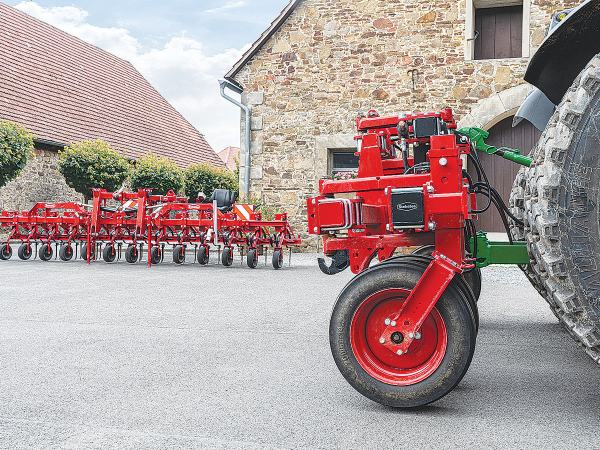
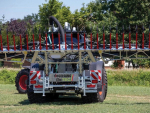
With growing interest in mechanical weed control to avoid the spiraling costs of herbicides, the Steketee EC-Steer parallel steering frame from German manufacturer Lemken turns un-steered hoeing machines from other manufacturers into implements with joystick or camera-controlled steering.
Offering a simple option for farmers or growers looking to upgrade their existing hoeing technology or swap between systems, a three-point mounted steering frame enables smooth and precise steering. Working with open lower link stabilisers at the tractor means there are no lateral movements being transferred between the tractor and the steering frame. Drivers can control the machine from their seat using a joystick or the IC-Light camera steering system. Camera steering enables the machine to differentiate between crop plants and weeds by recognising different shades of green or the RGB colour spectrum, resulting in automated hoeing to within two centimetres of the plant.
The parallel steering frame is available as an integral part of standard Steketee machines or as a stand-alone unit that can be used to upgrade other hoeing machines. Available in two versions, the EC-Steer 7 is suitable for hoes weighing up to 2,500kg and a maximum working width of six metres. An open three-point headstock allows a camera to be positioned centrally on the steering frame to cover a large field of view.
The EC-Steer 9 features a reinforced frame, so is suitable for larger hoes weighing up to 4,000kg and a working width of up to nine metres.
www.lemken.com