India FTA Removes 33% Tariff on NZ Sheepmeat
New Zealand’s red meat sector has welcomed the India-New Zealand Free Trade Agreement taking effect, which removes India’s 33% tariff on New Zealand sheepmeat.




 increase font size
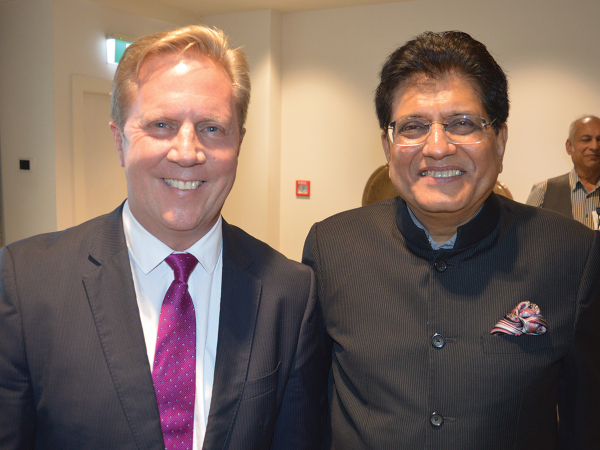 Trade Minister Todd McClay with Indian Commerce Minister Piyush Goyal in Auckland last week.
The dairy sector is hopeful of being part of a free trade deal being hammered out between New Zealand and India.
Dairy Companies Association of NZ chair Guy Roper told Dairy News that the joint commitment from the Prime Ministers of India and NZ in April was for a balances, ambitious, comprehensive and mutually beneficial trade agreement.
"We understand that comprehensive means covering the terms of importance to both sides, and, therefore, expect dairy to be part of an FTA," says Roper.
"We also understand the sensitivity of dairy within the negotiation - this has been well signalled from the outset - but we also believe there is significant scope for a closer trading relationship in dairy that benefits both countries."
Last week, India's Minister for Commerce and Industry Piyush Goyal was in the country for a fifth round of negotiations between the two countries. He also attended a NZ/Indian Business Summit with Trade Minister Todd McClay, Roper, an Indian trade delegation and local business leaders.
Asked if dairy would be part of an FTA between the two countries, Goyal replied that "we'll let you know in due course once we have finalised the entire agreement".
"The agreement must be seen in its entirety: it cannot be seen in just small parts. And what we'll have to look at the opportunities it unfolds for both countries," says Goyal.
"And in that context, we will give you all the details once it's finalised."
Goyal talked about "sensitivities" around the potential FTA.
The Indian dairy sector provides livelihoods to 80 million people and opening the sector to New Zealand imports wouldn't go down well with Indian farmers.
Goyal points out that India and NZ are "two very different sized economies".
"India is 1.4 billion people market. It's the fastest growing large economy in the world for several years now and and expected to continue to be the fastest growing economy for possibly a couple of decades in the future.
"We add more to the GDP every year than the entire New Zealand economy.
"So, in all this context, you have to see what is the balance that we can create in this agreement. And therefore, both sides are cognisent of the opportunities and of the sensitivities."
India is the world's largest milk producer, accounting for 24% of global milk production. It does, however, import a small amount of dairy products, buying $50m worth of products from NZ, making up 13% of total Indian imports.
Analysts believe India won't open its market for NZ dairy products. However, collaboration between the Indian and NZ dairy sectors is something the Indians could live with.
Indian public policy and business expert Ashok Malik told an India/NZ Business Summit earlier this year that with a population of 1.4 billion, India shouldn't be seen just as a market for products but for partnerships.
Roper says New Zealand's dairy exporting model is primarily about matching what it makes - world-class dairy ingredients - with the needs of food manufacturers and food service providers in other countries.
"At the heart of that trade is a value-chain partnership between New Zealand suppliers and their end-use customers, for either domestic consumption or for export to third markets.
"This model spurs economic activity and grows prosperity for both countries."
New Zealand’s red meat sector has welcomed the India-New Zealand Free Trade Agreement taking effect, which removes India’s 33% tariff on New Zealand sheepmeat.
More than 95 per cent of New Zealand’s forestry and wood exports to India can now enter tariff free as the New Zealand-India Free Trade Agreement comes into force today.
Zespri has welcomed the entry into force of the India-New Zealand Free Trade Agreement today, calling it a significant milestone that will support long-term growth in one of the world’s largest and fastest-growing consumer markets.
As part of its Election 2026 coverage, Rural News asked political parties how they would help pull the arable sector out of the doldrums. Here's what they said:
Food and fibre exports have returned a billion- dollar bonus to the country.


Federated Farmers has welcomed new rural policies released by ACT, saying they align closely with its own election priorities.
Rural Contractors NZ says proposed changes to land transport rules for agricultural vehicles are a welcome response by the Government to out of date regulations which have seen members hit with huge fines.
Alliance is calling for final applications for its 2027 Graduate Programme, with applications closing on Sunday 25 October.
Decades piloting planes has ensured vet and farmer David Hayes is focused on safety. So, after a serious accident while welding on farm, he is sharing his experience so others can learn from it.
Canterbury milk processor, Synlait Milk has confirmed Leon Fung as its chief executive officer.
OPINION: Making it easier to collect rainwater and use it to grow crops and livestock is a no brainer.

OPINION: It seems Canterbury processor Synlait is still in the doldrums.
OPINION: Get offside with New Zealand First leader Winston Peters at your own peril.




