
India FTA Removes 33% Tariff on NZ Sheepmeat
New Zealand’s red meat sector has welcomed the India-New Zealand Free Trade Agreement taking effect, which removes India’s 33% tariff on New Zealand sheepmeat.




 increase font size
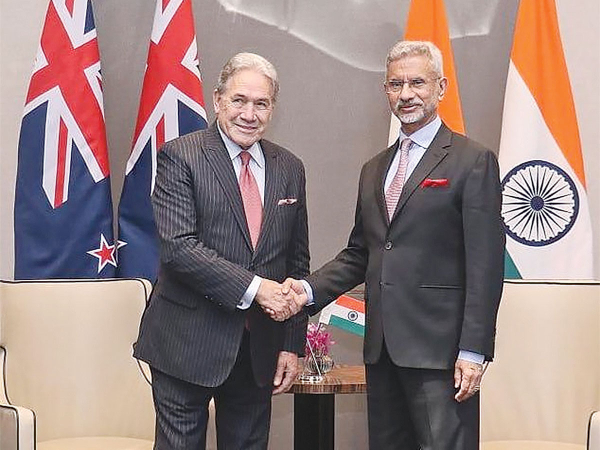 Foreign Affairs Minister Winston Peters meeting his Indian counterpart Subrahmanyam Jaishankar during a visit to New Delhi.
This past week has seen another round of negotiations between India and New Zealand to produce a free trade agreement (FTA) between the two countries.
A team of NZ officials from several government departments, led by the Ministry of Foreign Affairs and Trade (MFAT), have been in Delhi for talks with their Indian counterparts. These talks are between officials only and no politicians have been involved in the negotiations.
This latest round of talks is part of the ongoing process to reach agreement on an FTA. Every month there are four or five days of 'virtual' negotiations, followed up by face-to-face meetings between the two parties.
The FTA consists of 19 chapters or separate parts and is identical in structure to other FTAs that NZ has secured. The focus ranges from issues around rules, phytosanitary standards, a chapter on composition, services and, of course, trade.
While NZ is pressing for dairy to be included in the FTA, the chances of this are nil, and we are not being singled out in this regard. Britain and Australia, who have FTAs with India, also had dairy excluded from their respective agreements.
A couple of issues on the trade side that NZ is pushing hard on are apples and honey. Currently, India imposes a 50% tariff on apples which limits our ability to access that market. While India does produce apples, they are of course seasonal and what the NZ negotiators are trying to do is convince the Indians to allow NZ fruit in only when the local supply dries up.
The NZ position is that having apples on the market for 12 months of the year ensures that consumers have continuous supply which makes good marketing sense.
What NZ is saying is we will fill that gap in local supply and be gone when Indian fruit come on the market. This is an argument that we have successfully pursued with other primary products in the Northern Hemisphere.
The other issue is honey, and NZ is again trying to get access for manuka honey which has a high price point, well above the local produce.
The FTA with India is seen as a high priority for our government and it's proceeding at pace. The stakes are high. Over the past couple of weeks, NZ will have had about 15 people in Delhi at various stages of this latest round of talks. It's believed India will likely have double that number of people.
At the same time, the political tempo is being kept up with Trade Minister Todd McClay making regular trips to India along with Prime Minister Christopher Luxon there in March and Foreign Minister Winston Peters there some weeks ago.
New Zealand’s red meat sector has welcomed the India-New Zealand Free Trade Agreement taking effect, which removes India’s 33% tariff on New Zealand sheepmeat.

More than 95 per cent of New Zealand’s forestry and wood exports to India can now enter tariff free as the New Zealand-India Free Trade Agreement comes into force today.
Zespri has welcomed the entry into force of the India-New Zealand Free Trade Agreement today, calling it a significant milestone that will support long-term growth in one of the world’s largest and fastest-growing consumer markets.
A seasoned horticulturist has been appointed to deliver the Apple Action Plan, a key initiative of the India-New Zealand Free Trade Agreement.
National’s much-touted free trade deal with India featured in the Rural Issues Debate at Mystery Creek, Hamilton on Wednesday night.



Massey University is best placed to solve the “problems” facing the dairy industry, says vice chancellor, Pierre Venter.

Synlait's longest serving employee – a man who joined the Canterbury-based milk processor even before it began processing milk – is now its newest executive.
A dairy industry leader believes eradicating the common and costly disease, Bovine Viral Diarrhoea (BVD) is within reach.
A farmgate milk price of $10/kgMS this season is firming up as milk powder prices soar and the New Zealand dollar weakens.
Federated Farmers has welcomed new rural policies released by ACT, saying they align closely with its own election priorities.
Rural Contractors NZ says proposed changes to land transport rules for agricultural vehicles are a welcome response by the Government to out of date regulations which have seen members hit with huge fines.



OPINION: It seems Canterbury processor Synlait is still in the doldrums.
OPINION: Get offside with New Zealand First leader Winston Peters at your own peril.




