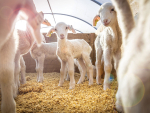
Maui Milk targets 500 litre ewe production by 2030 as leadership transitions
Sheep milk processor Maui Milk is on track to record average ewe production of 500 litres by 2030, says outgoing chief executive Greg Hamill.




 increase font size
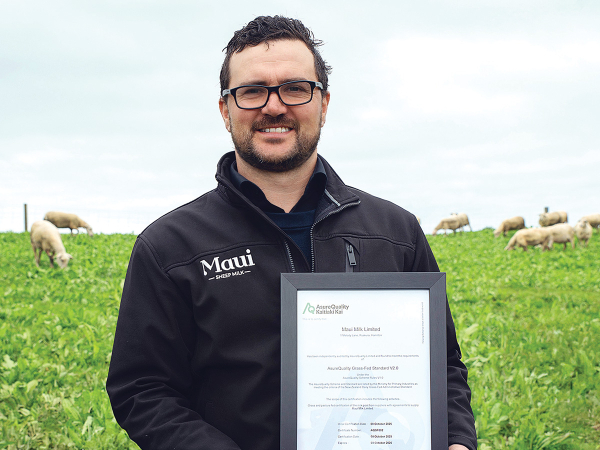 Maui Milk chief executive Malcolm Edward with the grass-fed certification.
Sheep milk processor Maui Milk has achieved grass-fed certification of milk supply against the AsureQuality Grass-Fed Scheme.
The company says this recognition reinforces its ongoing commitment to quality, sustainability, and animal welfare, and marks a significant achievement for the team, supply farmers, and customers.
State-owned AsureQuality works alongside New Zealand's primary producers and manufacturers, providing a broad range of independent services, including food safety, testing, auditing and certification. Maui Milk has elected AsureQuality as partner to provide independent auditing and certification services against the AsureQuality Grass-Fed Scheme.
"Through a rigorous and robust audit process, Maui Milk has demonstrated compliance with the AsureQuality Grass-Fed Standard, verification that our milk supply meets the requirements of the New Zealand Dairy Grass-Fed Administrative Standard, developed by the Ministry for Primary Industries (MPI)," the company says.
The standard defines what it means to be grass-fed in New Zealand, outlining clear criteria for:
AsureQuality's certification provides independent verification that Maui Milk's entire milk pool meets these requirements, offering assurance of integrity and authenticity to both customers and partners.
Maui Milk says that being certified grass-fed means that its trademarked Southern Cross dairy sheep are raised primarily on a diet of grass and forage, rather than grain-based feed.
Under the New Zealand Dairy Grass-Fed Administrative Standard:
This natural, pasture-based farming system:
Maui Milk received its grass-fed certification at the China International Import Expo in Shanghai this month from Agriculture Minister Todd McClay. A delegation led by McClay and including Dr Jonathan Austin, NZ Ambassador to China, Ardi Barnard, Consul-General in Shanghai, and Jenny Cameron, incoming MPI Deputy Director-General China Relations visited the Maui Milk booth.
Why It Matters
Maui Milk says its products are naturally nourishing, ethically produced, and backed by independent verification.
For consumers, grass-fed certification provides trusted and transparent assurance about how their dairy is producted.
For our milk processors and supply farmers, this certification ensures:
Sheep milk processor Maui Milk is on track to record average ewe production of 500 litres by 2030, says outgoing chief executive Greg Hamill.

Sheep milk powder and products exporter Maui Milk is partnering with one of China’s biggest dairy players to boost its market presence.
Dairy sheep and goat farmers are being told to reduce milk supply as processors face a slump in global demand for their products.
Dairy sheep and goat farmers are being told to reduce milk supply as processors face a slump in global demand for their products.
Sheep milk processor Maui Milk says it’s one of many companies being impacted by the imbalance between supply and demand for New Zealand sheep dairy products.


Mark Hooper has been appointed the new chair of NZPork, the industry organisation representing New Zealand pig farmers.

As the India-New Zealand free trade agreement enters into force, New Zealand’s apple industry has reaffirmed its commitment to the long-term development of India’s apple sector.
Fonterra shareholders can begin voting on Tuesday 20 October in the 2026 Board of Directors’ election, a Co-operative Council election in one Ward, and seven Annual Meeting resolutions.
National’s pledge to introduce 19 new national standards shows the party is serious about getting Wellington out of farming, Federated Farmers says.
The National Party’s policies to make it easier to grow fresh vegetables, secure reliable water and energy and simplify farm planning are practical changes that will give growers the confidence to invest, according to Horticulture New Zealand (HortNZ).
Fonterra Co-operative Group chief financial officer Andrew Murray has resigned to take up a role outside the dairy giant.


OPINION: It seems Canterbury processor Synlait is still in the doldrums.
OPINION: Get offside with New Zealand First leader Winston Peters at your own peril.




