Beef Progeny Test 2025: Genetic insights for NZ beef industry
At Pāmu’s Kepler Farm in Manapouri, mating has wrapped up at the across-breed Beef Progeny Test.




 increase font size
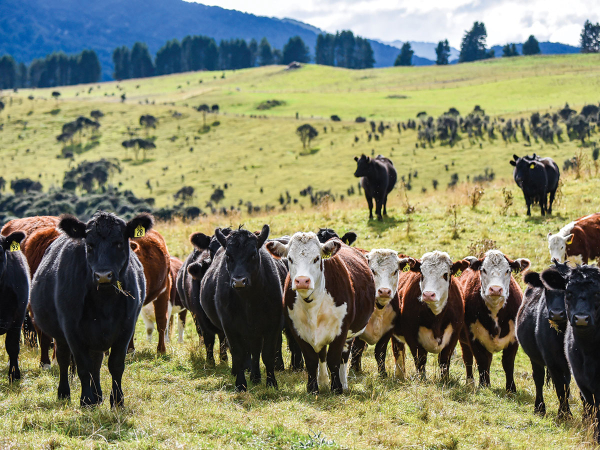 On Kepler farm, Hereford and Angus cows are run side-by-side with crosses undertaken both ways.
Mating wrapped up last month at the across-breed Beef Progeny Test on Pāmu’s Kepler Farm in Manapouri.
Now entering its sixth year, the progeny test is a cornerstone of the Informing New Zealand Beef (INZB) programme.
On Kepler farm, Hereford and Angus cows are run side-by-side with crosses undertaken both ways. This replicates the crossbreeding systems commonly used by commercial beef breeders across New Zealand.
Data is collected from conception through to processing, including carcase data from calves and reproductive data from heifers born into the programme. The test retains purebred and first-cross heifer progeny (where commercially viable), evaluating them under natural service for at least their first two matings. Last year’s mating at Kepler achieved a record 70% conception rate via artificial insemination.
Jason Archer, head of genetics at B+LNZ, says the Beef Progeny Test (BPT) plays a critical role in creating a stronger future for New Zealand beef farmers and the industry.
“It allows us to evaluate good bulls on the same level playing field while demonstrating the differences and similarities between the breeds, as well as the benefits of hybrid vigour - and the opportunities this presents for ongoing genetic improvement.”
Breeders of bulls selected for use in the BPT receive detailed information about the performance of their bull’s progeny, including processing data (in the case of steers).
The across-breed progeny test builds on data gathered from the original Beef Progeny Test (2014-2020), which compared bulls across several large-scale commercial beef operations nationwide.
B+LNZ continues to analyse the dataset collected over the course of the original Beef Progeny Test and the current across-breed Beef Progeny Test to provide valuable insights for stud breeders and commercial farmers.
A series of short articles by scientist and ‘data wrangler’ Dr Nicola Dennis brings to life some of these findings.
Topics covered include mature live weight and growth, the genetics of body condition scores, increasing beef marbling without excess external fat, carcase rib fat depth, and how ultrasound scanning can predict marbling in beef. The articles can be found on the B+LNZ website.
BCS for Bulls
Cow body condition score is one of the key factors to manage throughout the farming calendar.
A breeding cow with a bit of spare energy stacked on her back is more productive, more robust, and better-looking. But where does genetics come into all this? Could your bulls be working harder to produce full-bodied bovine goddesses of fertility?
Right now, there are no body condition score (BCS) breeding values calculated for most kiwi bulls. But outcomes from the B+LNZ Genetics Beef Progeny Test have shown that there could be.
Over 240 sires have been assessed for cow BCS in the B+LNZ Genetics Beef Progeny Test and more than 4500 cows have had their BCS measured at three time points: prior to mating, at weaning and prior to calving. There was quite a range of average cow BCS scores between sires (graph below). The heritability of cow
BCS was 0.26 indicating that around 26% of variation in cow chunkiness can be attributed to genetics. So, there is plenty of opportunity to add extra love-handles to your herd via bull selection.
The researchers also looked at related traits. There was a genetic correlation between cow BCS and the existing rib fat depth trait (measured via ultrasound in finishing animals). Bulls with a higher genetic merit for rib fat depth tended to have daughters with higher cow BCS. However, the genetic correlation (0.29) was not strong enough to consider rib fat depth a good predictor for cow BCS on its own. This means that rib fat depth EBVs only explains 8% of the variation in cow BCS. Likewise for the eye muscle area trait (4%).
And since rib fat depth and eye muscle area are measured in finishing animals which don’t have the demands of calving and lactating, there is a case to be made for adding a dedicated cow BCS breeding value to future genetic evaluations.
Dr Nicola Dennis
At Pāmu’s Kepler Farm in Manapouri, mating has wrapped up at the across-breed Beef Progeny Test.
This is the second in a series of articles from Beef + Lamb New Zealand’s Informing New Zealand Beef programme.
This is the first in a series of articles from Beef + Lamb New Zealand's Informing New Zealand Beef programme. The seven-year INZB partnership, supported by Beef + Lamb New Zealand and the Ministry for Primary Industries' Sustainable Food and Fibre Futures fund, aims to boost the sector's profits by $460m.
A further ten commercial beef farmers have been selected to take part in the Informing New Zealand Beef (INZB) programme to help drive the uptake of genetics in the industry.
New Zealand's primary sector is being called on to help shape the future of the country's industry by sharing views and insights about the availability and use of genetic tools.



Federated Farmers has welcomed new rural policies released by ACT, saying they align closely with its own election priorities.

Rural Contractors NZ says proposed changes to land transport rules for agricultural vehicles are a welcome response by the Government to out of date regulations which have seen members hit with huge fines.
Alliance is calling for final applications for its 2027 Graduate Programme, with applications closing on Sunday 25 October.
Decades piloting planes has ensured vet and farmer David Hayes is focused on safety. So, after a serious accident while welding on farm, he is sharing his experience so others can learn from it.
Canterbury milk processor, Synlait Milk has confirmed Leon Fung as its chief executive officer.
OPINION: Making it easier to collect rainwater and use it to grow crops and livestock is a no brainer.


OPINION: The same mainstream media muppets that brought you Jacindamania in 2017 have been flat out pimping for the Opportunities…
OPINION: Your old mate reckons the atrocious way farmers in the UK are treated by their lords and masters in…




