This is the first in a series of articles from Beef + Lamb New Zealand's Informing New Zealand Beef programme. The seven-year INZB partnership, supported by Beef + Lamb New Zealand and the Ministry for Primary Industries' Sustainable Food and Fibre Futures fund, aims to boost the sector's profits by $460m.
Focused on increasing the use of high-quality genetics in the beef industry, the four main components of the programme are developing New Zealand-specific breeding indexes, supporting the development of an across breed genetic evaluation and development of data infrastructure, running a beef progeny test and linking in data from commercial herds.
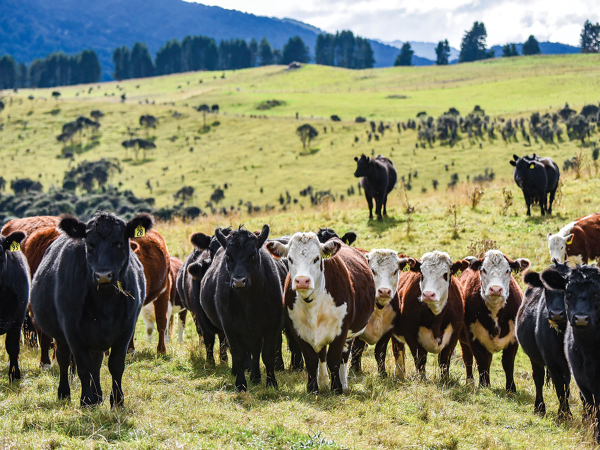
In a productive breeding herd, fatbottomed cows make the rocking farm go round. To get the most out of mating, we want to present the bulls with husky heifers and queensized cows. But how exactly does cow body condition score (BCS) affect breeding success?
Analysis of the B+LNZ Genetics Beef Progeny Test has found a linear relationship between cow BCS and conception rate. In other words - the chunkier the cow, the higher the chance she will conceive to a given mating (which in this case was a carefully timed artificial insemination). For every step up on the BCS scale, the rate of artificial insemination success increased by 5 percentage points.
However, conception rate isn’t the full story. Cows usually get more than one opportunity to conceive during a mating season. So, when the researchers look at the 49-day pregnancy rate (2+ oestrus cycles) there are diminishing returns for cows with higher BCS. The biggest gains are from getting the low conditioned cows closer to a BCS of 7 prior to mating.
Since cows’ curves don’t come for free, we also need to consider what it takes to put an extra BCS unit on a cow. It is easier to put condition on a lighter cow. At BCS 4 it takes 15kg of extra live weight to gain a BCS score (to get to BCS 5). This will take 83kg of dry matter intake over and above maintenance and production. But as we travel up the BCS scale this equation changes. The difference between BCS 7 and BCS 8 is 35kg of extra live weight for a tiny gain in the 49-day pregnancy rate.
So, when it comes to divvying up the pasture pie, it makes sense to focus on fattening up the Skinny Minnies rather than trying to put extra love handles on already well-conditioned cows.
Read More: