With the huge German Agritechnica Event scheduled to take place in Hanover in November, the next few months will undoubtedly see a host of manufacturers teasing us with some of their latest innovations.
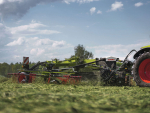
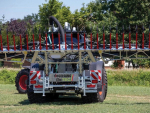
One of the first to show one of their latest ideas, Kuhn has released details of its GA 8131CL, an 8.0 metre, twin-rotor rake, that uniquely also features a 1.8m central pick-up assembly.
Over the last decade or so, twin-rotor rakes or swathers have become the “go to” for delivering large windrows to feed the increasing appetites of self-propelled foragers and round or square balers. Typically bringing the two outside rows of crop onto the central row, outputs can be increased, but the negative is a central move that sits on wetter ground and is flattened by the moved material.
Kuhn’s solution started as far back as 2016, with an idea to get more air into the crop, with several solutions considered, including a rotor that was eventually dismissed as it moved material to one side.
The patented idea sees a 1.8m wide pick up mounted on the main frame ahead of the twin rotors that lifts and aerates the central swath that is not worked by the rotors. Part of the standard specification of the rake, the 480mm diameter unit is hydraulically powered, with rotational speed controlled by a restrictor valve. Lifted and lowered automatically during headland turns, the swather has a minimum power requirement of around 60hp.
In other Kuhn news, the company will also premiere an autonomous solution for arable farms, running on rubber tracks, called Karl. Part of the company’s €400m spent on R&D over the last decade, the project began around six years ago, with four generations of prototypes being evaluated. The company stresses that Karl is not a tractor, rather a concept born from the ‘tools’ the implement manufacturer produces.