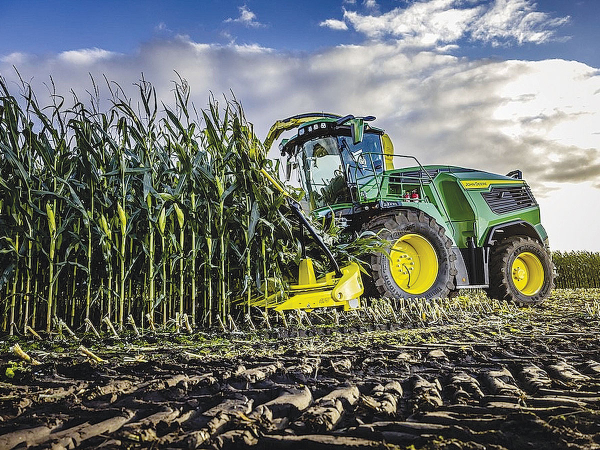
The arrival of new F8 and F9 designations for its 8000 and 9000 series forage harvesters, signals a swag of upgrades from John Deere, highlighted by topping the 1000hp mark for the first time.
Amongst numerous updates and options, the two main talking points are the engine and operator cabin cab. Like its X9 headers and 9RX tractors, the JD14X engine will feature in all of the F8’s six models, from 425hp in the F8 100 and 645hp in the flagship F8 600.
Moving to the F9 range, a JD18X engine will power the F9 500 (700hp), F9 600 (765hp) and the F9 700 (820hp). At the top of the range, the F9 900 and F 1000 are powered by a Liebherr 24.2 L V12, delivering 890hp and 1020hp respectively, with the latter gaining an extra 50hp over the current 9900 model flagship.
All models feature HarvestMotion technology to maximise productivity at reduced engine speeds and deliver constant power over a wide rpm range, resulting in excellent drivability for the operator and improved fuel efficiency.
A new, roomier cab on both ranges comes across from the combine harvester ranges, offering more storage space, areas for hot and cold drinks, with dedicated holders for smartphones, keys and larger items, alongside 12v and USB connection points.
A new CommandPRO joystick is complemented by the G5/G5Plus CommandCenter touchscreen, featuring a new forage harvester-specific menu allowing operators to quickly access and adjust the machine’s main functions.
The console is reported to 35% larger and 75% faster than previous consoles, while incorporating a 1080P high-definition display.
The F8 and F9 can be equipped with advanced automation and John Deere Precision Ag Technology, including Ground Speed Automation, Intelligent Crop Tracking or ProTouch Harvest. Regardless of conditions, Ground Speed Automation ensures the machine constantly harvests at maximum productivity and optimal efficiency while minimising operator effort and stress.
Active Fill Control uses a stereo camera system to control the rotation and flap position of the spout automatically, tracking transport vehicles and aiming the crop for ideal fill strategy.
The ProTouch Harvest system offers single-click headland automation for maize, grass, or whole crop silage, managing header lift, spout control, AutoTrac, Active Fill Control, and Ground Speed Automation for easy headland turns. In addition, when switching between road and field, ProTouch technology handles up to nine essential functions, including beacon lights, 4WD, settings for engine speed management, and spout positioning.
Operator comfort is taken care of by the latest ActiveSeat that swivels 16° in both directions, while the optional Active- Seat II offers fully adjustable electric controls, including cooling/heating and massage functions.
Revised spout geometry allows up to 230° of rotation, a redesign of the rear axle’s steering system reduces the turning radius to 6.0m, while there is also the choice a new inoculant dosing system.
The new inoculant dosing system, IDS 2.0, works with HarvestLab sensor readings to optimise silage quality with a 50-litre insulated concentrate tank for highly concentrated additives and a 325-litre tank for high volume applications and water.
Customers can also choose from two new advanced kernel processor options, including the Ultimate 250TM kernel processor with larger 250mm diameter rollers, temperature monitoring and foldable design for best serviceability. The second optional is the XStream 305 kernel processor that delivers a 56% larger surface with 305mm diameter rollers, electrical adjustment and the well-proven oil-mist greasing for best processing in all length of cuts.