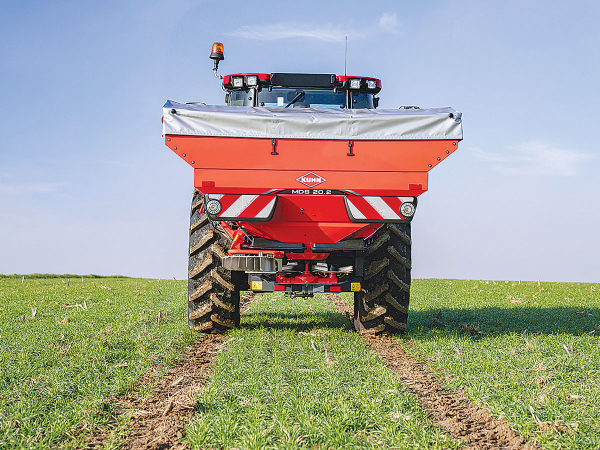
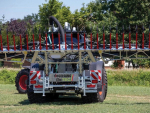
Kuhn has updated its MDS range of fertiliser spreaders, giving farmers more options to upgrade machines as situations change, rather than having to change to a new machine.
Offered as four base twin-disc machines, the MDS 8.2, 14.2, 18.2 and 20.2 have maximum capacities of 800, 1400, 1800 and 2000 litres respectively.
The MDS 8.2 and 14.2 feature a slim profile with respective overall widths of 1.08m and 1.40m, making them ideal for vineyard or orchard applications, or for any crops planted at narrow row spacing.
The larger 18.2 and 20.2 models are intended for livestock or arable operations, utilising a flexible hopper extension system to achieve high load capacities that in turn help increase daily outputs and reduce empty travel for refilling.
In the K and D versions, the individual outlet slides are operated using single or dualacting hydraulics remote valves from the tractor. For enhanced control, the electric metering outlet control option sees one actuator for each outlet, to offer more reliability and precision, controlled via the simple E-Click switch box.
For optimal control, the Quantron A terminal electronically adjusts the metering outlets to maintain a consistent flow rate irrespective of ground speed, meaning a target rate is always dialled in and maintained.
During spreading, the system also allows operators to modify the application rate, simultaneously close either discharge shutter with a simple button and Varispread 8 comes as standard, with section control with eight sections-four on each side, controlled manually or by GPS.
www.kuhn.co.nz