
ANZ Warns of Milk Price Risks as New Dairy Season Begins
The new dairy season is kicking off with plenty of risks to the forecast farmgate price, both upside and downside, says ANZ agricultural economist Matt Dilly.




 increase font size
 Westland chairman Matt O'Regan.
New Zealand's second biggest dairy cooperative Westland Milk Products has released a budget for the 2016-17 dairy season of $4.55 - $4.95/kgMS.
Payout for the current season will be in the range of $3.80 - $3.90/kgMS.
Westland will also start its payout advance payments for the 2016/17 season at $3.80/kgMS payable September 20, 2016.
Chairman Matt O'Regan says, "This will provide much needed cash as early in the season as possible. Advance rates are budgeted to be phased down then stepped up, an approach similar to previous seasons."
O'Regan says the 2016/17 forecast while predicted to end with a better result than the 2015/16 season, still leaves farmers with cash flows well below their cost of production. The board and management will be looking for every opportunity to get as much cash to farmers as possible.
Chief Executive Rod Quin says the key influencers on payout are international market prices, foreign exchange rates, the contribution of Westland's value-add strategy, milk flows and expenses.
"The contribution to payout of our strategic move into value-add products – infant nutrition, EasiYo, retail butter and UHT milk and cream – is worth noting," Quin says. "Collectively, their value over and above the earnings we can expect from skim milk powder is budgeted at 48c per kgMS."
Quin says while Westland's pay out prediction is more optimistic than the current season, the market still faces a number of challenges.
"Prices remain under pressure as European and US dairy stock piles are now a feature of the market. Early contracts in our sales book are in line with budgeted prices, but market volatility with price movements, both up and down that can be sudden, make forecasting difficult.
"Based on what we see in the market today, with a forward view of global stock levels, customer demand and milk flows, we anticipate some minor increases for whole milk powder. However, we do expect pressure on skim milk and butter prices."
The new dairy season is kicking off with plenty of risks to the forecast farmgate price, both upside and downside, says ANZ agricultural economist Matt Dilly.
As expected, Fonterra has lifted its 2025-26 forecast farmgate milk price mid-point to $9.50/kgMS.
OPINION: The year has started positively for New Zealand dairy farmers and things are likely to get better.
Dairy farmers are still in a good place despite volatile global milk prices.
OPINION: What goes up must come down. So, global dairy prices retreating from lofty heights in recent months wouldn’t come as a surprise to many farmers.


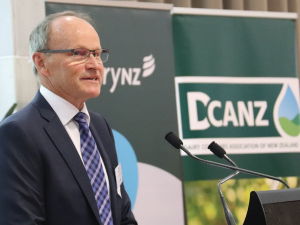
Dairy processors are ready to further boost New Zealand’s export earnings but want the incoming government to match their ambition with good policy.

Massey University is best placed to solve the “problems” facing the dairy industry, says vice chancellor, Pierre Venter.
Synlait's longest serving employee – a man who joined the Canterbury-based milk processor even before it began processing milk – is now its newest executive.
A dairy industry leader believes eradicating the common and costly disease, Bovine Viral Diarrhoea (BVD) is within reach.
A farmgate milk price of $10/kgMS this season is firming up as milk powder prices soar and the New Zealand dollar weakens.
Federated Farmers has welcomed new rural policies released by ACT, saying they align closely with its own election priorities.



OPINION: It seems Canterbury processor Synlait is still in the doldrums.
OPINION: Get offside with New Zealand First leader Winston Peters at your own peril.




