Southerly Winds Hit Taranaki Dairy Pasture Growth
A spate of southerly winds bringing cold temperatures has presented challenges for Taranaki dairy farmers.




 increase font size
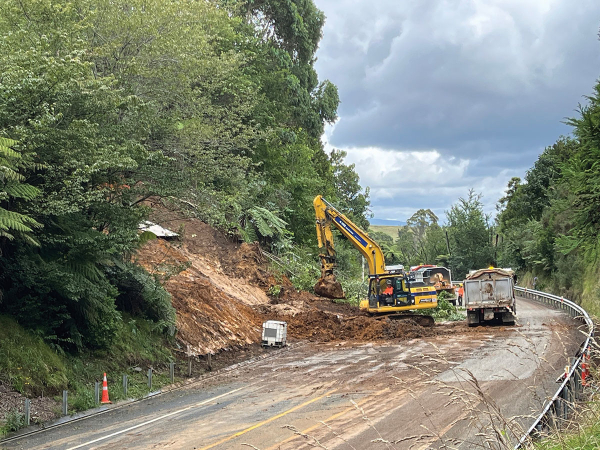 While most dairy farms in North Island were spared by the recent spate of storms, the same cannot be said about state highways.
For the most part, dairy farmers in the Waikato, Bay of Plenty, Tairawhiti and the Manawatu appear to have not been too badly affected by recent storms across the upper North Island.
Many of the areas hit badly were not major dairy producing areas. Even in the regions affected, reports suggest that the damage is localised and not widespread, as was the case with Cyclone Gabrielle.
The western Bay of Plenty was hit, causing a deadly slip at Papamoa. The other region badly affected was the East Coast, in particular, settlements around Te Araroa and down the coast towards Gisborne.
Peter Andrews of AgFirst in Gisborne says the main issue in his region is damage to roads with SH2 through the Waioweka Gorge from Gisborne to Opotiki closed and the road around the coast SH35 also blocked.
He says there are not many dairy farms in the region and he believes Fonterra is taking care of them. However, he points out the only way north is first to drive south and take the Napier-Taupo road.
"This is a big issue especially for horticulture because soon a lot of kiwifruit is going to be harvested and normally this is packed in Opotiki. So, it's a nightmare for those people and also for some farmers that have produce going north, because it adds another 211km one way to the journey," he says.
But while some roads remain closed, Andrew says he hasn't received any reports of widespread damage on farms. He adds he's not aware of any bridges knocked down.
However, farms at the top of the East Coast have been badly hit and reports of damage are still coming in.
The eastern Bay of Plenty appears to have got off relatively lightly. AgFirst's Mark Macintosh from Whakatane says while the region got a lot of rain, it was steady over about a day.
"We didn't get short, heavy downpours that cause the damage and we didn't get the flooding between Whakatane and Opotiki that we would normally expect," he says.
Macintosh says there appears to be limited damage to farms, although he says closer to Western Bay of Plenty there are signs of trees being blown down.
"On some dairy farms the odd tree might have come down on a stock race but from what I've heard there's been no reports of major damage," he says.
Federated Farmers Bay of Plenty president Brent Mountfort says the damage to farms in the region as a whole was localised and not widespread. He says the dairy farmers, who are mainly on the flats, appear for the most part to be okay.
"The rain was heavy but unlike many other places there were no sudden heavy, damaging downpours. There will be some slips on farms and looking at my own place on the hills above Matata, there are signs of erosions in the gullies," he says.
Mountfort says interestingly not all the logs and debris found on beaches are from production forestry and some areas where there is a problem, it is all native bush and not pine trees. He says while the rain is a problem, it's the logs and debris that destroy bridges and fences and, apart from East Cape, there doesn't seem to be a problem across the region.
Welcome Rain
The Waikato appears to have got off lightly in the latest storm, according to AgFirst CEO James Allen.
He says the damage in the Waikato is nothing like what has occurred in other regions. He says maize crops have been affected - but adds that this is not too bad.
Allen says the storm did knock down trees, which in turn saw power cut to some dairy farms for a short period of time, and things were a bit dramatic for some people, but they seem to have recovered well.
"On a positive note, people have had between 50 mils and over 100 mils of rain, so farms are actually looking pretty good; we are well set up for say the next six weeks," he says.
Down in the Horowhenua, DairyNZ director Richard McIntyre says the rain was welcome. He says his farm was starting to get dry but now it's greened up and the grass is growing. McIntyre says he's been feeding a small amount of supplement to his cows in the form of a summer crop of chicory and turnips.
"But in years gone by, we would be using a lot more supplementary feed in the form of silage, so things are holding pretty nicely at the moment," he says.
McIntyre says he very much feels for those farmers in other parts of the country who have suffered damage from the recent storms.
A spate of southerly winds bringing cold temperatures has presented challenges for Taranaki dairy farmers.
Surprised, humbled and quite thrilled. That’s the reaction of James Allen, one of the founding partners and now chief executive of AgFirst, on being made a life member of the Institute of Rural Professionals.
A warning to dairy farmers not to expect the same good conditions that they experienced last season, has been issued by a leading farm consultant.
As fuel and fertiliser prices rise and with uncertainty in the future, farmers are being urged to go over their budgets with a fine-tooth comb.
OPINION: First on the scene after the recent devastating storms in parts of the North Island were emergency services and selfless members of the public.


Farmer-owned fertiliser company, Ballance Agri Nutrients is welcoming National’s plan to negotiate security agreements with key supplier countries to protect New Zealand-bound products from export restrictions and greater supply chain certainty.

Carrfields has announced the appointment of Stu Hall to the newly created role of chief operating officer, Carrfields Ltd, reflecting the continued growth of their agribusinesses and the need to ensure the company has the leadership capacity and support in place as it pursues the emerging opportunities ahead.
New Zealand's role is not to compete with Indian growers, according to NZ Apples and Pears.
The potato industry is celebrating the success of two rising stars - James Blair, the 2026 Young Grower of the Year and runner-up and innovation award winner, Amber Davy.
Twenty-eight emerging leaders from across the horticulture sector spent two days last month learning valuable skills and connecting with industry experts.
There are five entrants in this year’s Young Horticulturist of the Year, competing in a series of technical, practical, business and leadership challenges.
OPINION: It seems Canterbury processor Synlait is still in the doldrums.
OPINION: Get offside with New Zealand First leader Winston Peters at your own peril.