Sad ending: Happy Valley Nutrition faces deregistration
The end of the road is nigh for a former Australian-listed company, Happy Valley Nutrition, behind a failed dairy factory project in Otorohanga.




 increase font size
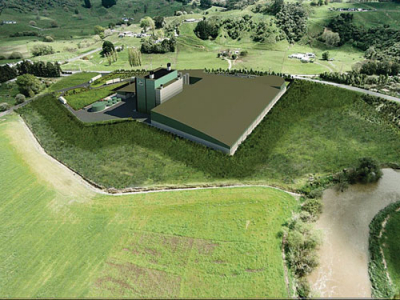 An artist’s impression of Happy Valley Milk’s plant in Otorohanga.
Land use consent has been granted for a new $230 million infant formula plant on the outskirts of of Otorohanga, Waikato.
Happy Valley Milk’s land consent application was strongly opposed by some residents including Fonterra Shareholders Council chairman Duncan Coull, who milks 700 cows on two farms 6km from the proposed site.
The opponents queried the economic viability of the project and expressed concern about increased traffic and noise levels.
However, independent hearing commissioners Alan Withy and Phil Michell last week approved the application with 73 conditions, including factory size and noise control.
The Otorohanga District Council received 69 submissions -- 34 in support, 30 opposed and four neutral.
The commissioners ruled that the proposed milk plant will have significant economic benefits for the Otorohanga township and wider district.
“We have given careful consideration to the issues raised by Mr Coull, and others, who question the economic viability of the proposal and whether or not Happy Valley Milk Ltd will be able to secure milk supply contracts and operate in a commercially viable manner.
“The reality of the situation is that if the applicant cannot secure milk contracts, the proposal will not proceed and that is a matter for the applicant and milk suppliers to negotiate. As Ms Barry-Piceno (Happy Valley lawyer Kate Barry-Piceno) noted, case law has made it clear that those types of economic viability decisions are for ‘the boardroom, not the courtroom’ and we accept that.”
While the commissioners accept that project-related traffic is of concern to neighbours and other road users, they are satisfied that the proposal meets accepted standards.
On noise effects, they were satisfied “that the noise limits proposed for construction and operational traffic are appropriate”.
Happy Valley Milk founder and director Randolph van der Burgh says his company is pleased with the decision.
The company is now making submissions to the Waikato Regional Council on water use; construction work will start once water use consents are received.
Van der Burgh says the company had planned to start production in the 2019-2020 season but the project will be delayed about six months by the lengthy land use consent process.
Farmers around the factory will be offered milk supply contracts once construction work starts.
“We will be doing some soft selling but we’ll wait until construction work starts [before we] approach farmers,” he told Dairy News.
“We expect some farmers to switch supply to us; others may want to stay with Fonterra… it’s entirely up to each farmer.”
The end of the road is nigh for a former Australian-listed company, Happy Valley Nutrition, behind a failed dairy factory project in Otorohanga.

After struggling for years to secure capital, a proposed greenfield milk plant project in King Country has collapsed.
Owners of a new milk processing plant planned in Waikato say construction will start once funding has been secured.
Waikato should have a new $280 million milk plant up and running by August 2021.
A proposed $230 million infant formula plant in North King Country is opposed by some local landowners, including a Fonterra leader.


Minister of Conservation Hon Tama Potaka has appointed Susan O'Regan as Chair of the Queen Elizabeth II National Trust (QEII) for a three-year term.
Red meat farmers are welcoming Labour’s plan to review the Emissions Trading Scheme and not to campaign on pricing agricultural emissions.
Where any worker in the kiwifruit industry is mistreated, we expect the authorities to take action.
Mid Canterbury Federated Farmers arable chair, Bevan Lill, said Beef + Lamb NZ data indicated that for the last six years, the average arable return on investment was about 0.8% while inflation ran about 4% - so the average arable farm was going backwards at about 3% a year.
Seed and grain companies share the concerns of arable farmers about the viability of their sector, says Seed and Grain New Zealand chief executive Dr Sarah Clark.
The New Zealand Institute of Forestry (NZIF) says unnecessary changes to New Zealand’s Emissions Trading Scheme (NZ ETS) will seriously erode investor confidence and result in significant reductions in forest planting rates.



OPINION: It seems Canterbury processor Synlait is still in the doldrums.
OPINION: Get offside with New Zealand First leader Winston Peters at your own peril.