Fonterra Elections 2026: Voting Opens Tuesday 20 October
Fonterra shareholders can begin voting on Tuesday 20 October in the 2026 Board of Directors’ election, a Co-operative Council election in one Ward, and seven Annual Meeting resolutions.




 increase font size
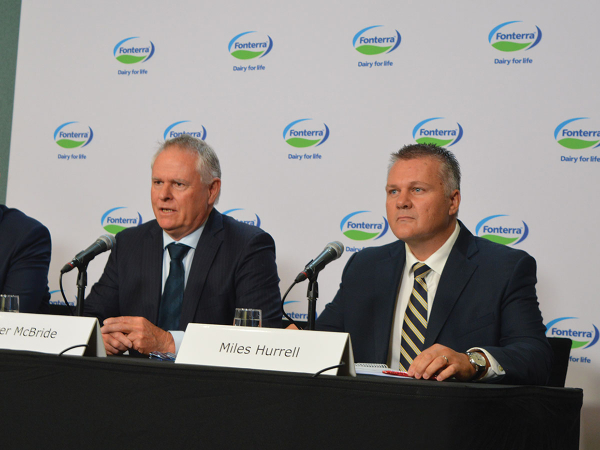 Fonterra chair Peter McBride and chief executive Miles Hurrell discuss the co-op’s interim results last week.
Fonterra says it's keeping an eye on the Middle East crisis and its implications for global supply chains.
However, chief executive Miles Hurrell says the co-operative is comfortable with its latest forecast farmgate milk price, which has a new mid-point of $9.70/kgMS.
Hurrell says the forecast range reflects their well-contracted sales book and the firming of global dairy prices during February and March.
The co-op has also lifted its forecast earnings guidance from containment operations - from 45c to 65c/share to 50c to 65c/share.
"This reflects higher sales volumes forecast in the second half and also takes into account uncertainty related to the Middle East conflict," he says.
"We're well-versed at trading through supply chain disruptions, however the situation in the Middle East remains highly unpredictable and we continue to monitor the situation closely."
If the conflict persists and Middle East markets are completely closed off, then Fonterra's full year results would be impacted.
"We are well-contracted for the year but if you see the markets completely closed off throughout the Middle East, we are getting product into that part of the world, albeit with some disruption.
"But if you saw that completely close down, for argument's sake, and we couldn't get product at all there, and cost started to increase, you could start to see that impact."
But Hurrell says he's confident that the current farmgate price range will hold.
He points out that the Gulf states need product for their people.
"In the GDT event, the largest buyers were from that part of the world, which suggests that they're still looking for product to supply to their people."
Shipping remains a major worry for exporters around the world. But Hurrell says their Kotahi joint venture with meat company Silver Fern Farms and relationship with global shipping giant Maersk is helping them move product.
"We saw that pay its way through Covid disruption and we've seen it again now.
"So those long-term partnerships that you have in place really come to the fore in times like that."
RaboResearch senior market strategist Benjamin Picton says the critical Strait of Hormuz remains mostly closed to shipping.
"This is a huge problem for the global economy, as a large proportion of the global supply of certain goods typically pass through the Strait on their way to global markets.
"The most obvious of these is oil, where up to 20% of the global supply is now facing disruption.
"In addition to oil, refined fuels are also affected (15-25% of global supply), urea (30%), sulphur (45%), helium (30%), methanol (46%), and liquified natural gas (20%)."
He notes that New Zealand's liquid fuel supply is now 100% imported since the 2022 closure of the Marsden Point refinery, which had previously provided up to 70% of the country's refined fuel needs.
"Most of our fuel now comes from refineries in Asia, who in turn rely on the Middle East for 60-70% of their crude oil feedstocks. Consequently, the upstream of New Zealand's liquid fuels supply chain is facing sever strain as Asian refineries reduce production runs and, in some cases, exports of fuel are capped or banned altogether."
Waikato Federated Farmers dairy chair Matthew Zonderop says the fuel crisis is a bit concerning for farmers.
"But there's nothing we can do about it," he told Dairy News.
"We just have to continue on the same as what we're doing."
Fonterra shareholders can begin voting on Tuesday 20 October in the 2026 Board of Directors’ election, a Co-operative Council election in one Ward, and seven Annual Meeting resolutions.

Fonterra Co-operative Group chief financial officer Andrew Murray has resigned to take up a role outside the dairy giant.
Four candidates have been confirmed for two director positions on Fonterra’s board.
A record farmgate milk price and strong global demand is laying the foundation for continued growth of organic dairy farming in New Zealand.
Waikato milk processor Tatua has again declared a record milk payout to farmer shareholders, leaving other processors in the dust.



Federated Farmers has welcomed new rural policies released by ACT, saying they align closely with its own election priorities.

Rural Contractors NZ says proposed changes to land transport rules for agricultural vehicles are a welcome response by the Government to out of date regulations which have seen members hit with huge fines.
Alliance is calling for final applications for its 2027 Graduate Programme, with applications closing on Sunday 25 October.
Decades piloting planes has ensured vet and farmer David Hayes is focused on safety. So, after a serious accident while welding on farm, he is sharing his experience so others can learn from it.
Canterbury milk processor, Synlait Milk has confirmed Leon Fung as its chief executive officer.
OPINION: Making it easier to collect rainwater and use it to grow crops and livestock is a no brainer.




OPINION: It seems Canterbury processor Synlait is still in the doldrums.
OPINION: Get offside with New Zealand First leader Winston Peters at your own peril.




