
Four Candidates Confirmed for Fonterra Board Election
Four candidates have been confirmed for two director positions on Fonterra’s board.




 increase font size
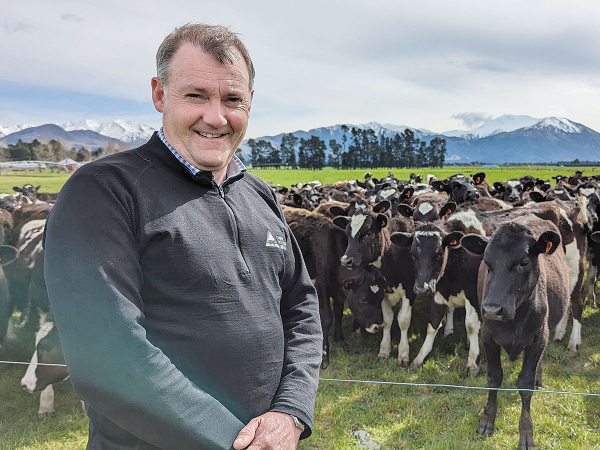 Colin Glass agrees that a governance role with Fonterra is something that "gets raised from time to time".
After 25 years it is the right time to step away, says Colin Glass, the retiring chief executive of New Zealand's largest private corporate dairying company, Dairy Holdings.
Glass, who stood down at the end of May, said that moving on has given him the chance to reflect, and appreciate that what was created in Dairy Holdings was "quite special".
"As always, it's about the people that you deal with rather than necessarily what you achieve, but certainly the company's gone from strength to strength, from what was reasonably humble beginnings way back in 2001, to what it's become now," he said.
"Very, very proud of the team and some of the underlying success stories that I've had the privilege of being involved with," he told Dairy News.
For the immediate future, Glass is now concentrating on the family dairy and bull beef farm at Methven he shares with wife Paula and daughters Hannah and Olivia and seeing how it can be further developed.
However, it's clear that governance roles in the industry may not be too far down the track, and Glass agrees that a governance role with Fonterra is something that "gets raised from time to time".
"It's not something that I'm considering just at the current point in time.
"But certainly, you know, Fonterra's success is New Zealand's dairy farming success. So, I've certainly got an eye on that, potentially in the future at some stage, but not at the moment."
Dairy Holdings now holds around 90 farms, both dairy and support, producing around 33 million kgMS annually.
Under Glass's leadership the company continued to grow right to the end of his tenure, with the acquisition of the Rangitata Partnership's farms, under a deal which only went unconditional on his last day at work, and was settled on the Wednesday of the following week.
With Rangitata holding several dairy farms in South Canterbury and a large grazing block in Tarras, Glass said it was "quite a large transaction and good one to get under our belt at the end".
Glass said the success of the company was the testament to the vision and courage of the founders, Allan Hubbard, Colin and Dale Armer, and Alan Pye, to pick up the farms of the former Tasman Agriculture and Dairy Brands groups when their then owners decided to sell up in 2001.
As Tasman Ag's chief financial officer at the time, Glass came with the deal and he proceeded to lead the new company through an extraordinary growth period for dairying.
Glass said many of the challenges of the early years were the sometimes very involved legal processes around water take consents that had to be pursued through various regional council hearings and in some cases all the way to the Environment Court.
"Out of all of that, there were some amazing learnings and that really has set Dairy Holdings up for the future.
"Most of those 70-odd dairy farms in Canterbury now are all incredibly well irrigated with reliable, relatively low-cost, and affordable water. That's really added to the company's low-cost farming model. So it's meant that the overall portfolio is now really, really resilient and able to understand most price shocks.
"The piece for me that was quite nice, was how the team and everyone involved at that time was able to take some of those challenges and knockbacks and learn from them, and it was out of that that the company really grew.
"When you look back now, any difficult times we experience is always what makes you stronger. Never have you finished your learning and if you just stay focused, you can always get there in the end."
While the growth in the dairy industry of the last 20-odd years will never be replaced, there was currently some resurgence of dairy conversions going on.
However, it was being done in a very sustainable way, says Colin Glass.
Dairy farming had massively changed over the years with state-of-the-art irrigation, AI-driven algorithms and other technologies transforming efficiency.
"That's been happening right across the dairy industry as people have developed their own farming systems and models and invested in their farms," he says.
"There's more riparian planting, there's a beautification of farms like we've really not seen in the generation, and so you've got a real sense of pride in ownership within the sector that that only comes with success."
Dairy remained the absolute cornerstone for rural New Zealand and so many businesses livelihoods were dependent on it, he says.
"Thank goodness that we do have dairy because if we didn't, you know there wouldn't be too much really holding up the New Zealand economy at the moment."
Four candidates have been confirmed for two director positions on Fonterra’s board.
A record farmgate milk price and strong global demand is laying the foundation for continued growth of organic dairy farming in New Zealand.
Waikato milk processor Tatua has again declared a record milk payout to farmer shareholders, leaving other processors in the dust.
Fonterra has unveiled its annual results for the 2026 financial year, posting $27 billion in revenue and close to $20 billion returned to New Zealand farmer owners and unit holders.
Fonterra Co-operative Group has confirmed the independently assessed candidates standing for election to its board in 2026.


Veterinarians say changes to the code of welfare for dairy cattle provides a positive foundation for improved cattle welfare across the country.
Today, 15 October, is the International Day of Rural Women, which recognises rural women’s contribution to farming, communities and the environment.
Global dairy giant Lactalis has integrated its Australian operations with the Mainland Dairy consumer business it acquired from Fonterra earlier this year.
After almost two decades of sharemilking, saving and building equity, Aaron and Marcia Flay this year realised their long-held dream of settling on their first dairy farm.
Good medium to long term prospects for NZ beef, especially in the US, has heighted the focus on various initiatives to capitalise on this situation.
High country stations, mixed sheep and beef farms, Māori-owned farms, corporates and family operations are among the nine commercial farms taking part in the Livestock Innovation Farming Transformation programme, known as LIFT.
OPINION: It seems Canterbury processor Synlait is still in the doldrums.
OPINION: Get offside with New Zealand First leader Winston Peters at your own peril.




