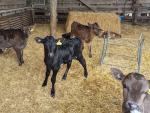
Collars, BCS help reduce empty rates
The Lincoln University Demonstration Dairy Farm (LUDF) is crediting a raft of improved management practises in achieving a big turnaround in empty rates.




 increase font size
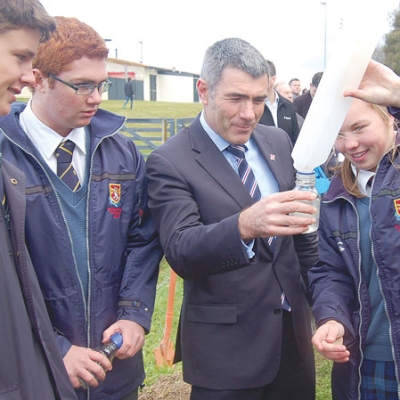 Primary Industries Minister Nathan Guy with St Peter’s School students.
The Saint Peter’s School-Lincoln University demonstration dairy farm at Cambridge in the Waikato has secured two sponsors.
PGG Wrightson Seeds and Ballance Agri-Nutrients recently signed partnership agreements with Lincoln University.
Lincoln vice chancellor Dr Andy West said at a signing ceremony that industry support is needed for the farm to achieve its ambitious goals.
“We [invited] a number of organisations… to be sponsors and partners and were delighted with the response. PGG Wrightson Seeds and Ballance Agri-Nutrients are our founding partners and we will be announcing others in coming weeks.
“The partners share a commitment to collaborate and apply their skills to developing this demonstration farm so it is profitable and environmentally sustainable.
“It’s fair to say that farmers are custodians of the land and a large portion of the New Zealand environment and this farm will provide farmers with tangible ways to farm sensitive catchments profitably and sustainably.
“This is pastoral farming and the quality of the forages that go to make up those pastures largely dictates how well a farm performs, so having PGG Wrightson Seeds… supporting this demonstration farm is encouraging.”
Launched in August 2014, the demonstration dairy farm aims to be in the top 3% of dairy farms in the region for profitability and environmental performance, promoting sustainable dairying through collaborative research, education and training.
PGG Wrightson Seeds general manager David Green says the need to farm within environmental limits was one of the reasons it became a sponsor.
“The intensity of modern farming systems and the need to balance production within environmental limits presents farmers with a unique set of challenges.
Forage provides one answer so we are delighted to collaborate with other like-minded organisations in a property which will become a showcase for sustainable and profitable farming.
“PGG Wrightson is also a large employer of undergraduates and graduates within the agricultural framework and we welcome any opportunity to showcase the opportunities which abound in the many facets of New Zealand’s primary industries.”
Ballance Agri-Nutrient’s chief financial officer, Richard Hopkins, says the fertiliser co-op is excited to be part of the demonstration farm.
“The key demonstration objective is to develop and demonstrate how to farm profitably within strict environmental limits and this aligns closely with our own core objectives.
“We already sponsor the Ballance Farm Environment Awards and this demonstration farm represents another opportunity for us to support our shareholders and the wider industry.”
Farm facts
The St Peter’s - Lincoln demonstration dairy farm has been a working dairy farm since the St Peter’s campus was developed in the 1930s.
Today it comprises 183ha eff, milking 470 cows in the current season. The farm is situated along 4km of the Waikato River. Soil types vary markedly, from wetter soil types on the northern side to sandy river soils closer to the river. It has small pine plantations and gully sidings and streams now being fenced off and planted with native trees and shrubs.
Average pasture cover is 2200kgDM/ha.
On-site field days, on-line research and education through the St Peter’s and Lincoln curricula are in the pipeline.
The farm will be governed by a committee of leading Waikato dairy farmers, scientists from Lincoln University and sponsors.
The Lincoln University Demonstration Dairy Farm (LUDF) is crediting a raft of improved management practises in achieving a big turnaround in empty rates.
The Lincoln University Dairy Farm (LUDF) is rethinking its approach to plantain, in the face of continued difficulty in realising its expected benefits.
It was the battle of the wearables at the recent Lincoln University Demonstration Dairy Farm Focus Day with presentations of three different electronic monitoring and management systems.
A flexible milking regime adopted this season on the Lincoln University Demonstration Dairy Farm (LUDF) is going "surprisingly well', says the farm administrator Jeremy Savage.
Three new farming systems are being implemented to expand Lincoln University Dairy Farm’s (LUDF) focus and extend its outlook through to 2030.



Rural Contractors NZ says proposed changes to land transport rules for agricultural vehicles are a welcome response by the Government to out of date regulations which have seen members hit with huge fines.
Alliance is calling for final applications for its 2027 Graduate Programme, with applications closing on Sunday 25 October.
Decades piloting planes has ensured vet and farmer David Hayes is focused on safety. So, after a serious accident while welding on farm, he is sharing his experience so others can learn from it.
Canterbury milk processor, Synlait Milk has confirmed Leon Fung as its chief executive officer.
OPINION: Making it easier to collect rainwater and use it to grow crops and livestock is a no brainer.
As part of its Election 2026 coverage, Rural News asked political parties how they would help pull the arable sector out of the doldrums. Here's what they said:
OPINION: It seems Canterbury processor Synlait is still in the doldrums.
OPINION: Get offside with New Zealand First leader Winston Peters at your own peril.




