While feeding dairy animals in New Zealand is largely centred around feed trailers, mixer wagons or baleage, one wonders whether there is a place for robotic feeders, particularly in South Island locations, where cows are housed during winter or full time.
Relatively new to NZ, the Euromilk brand sees the Rhino Vertical mixer wagons of 22 to 32 cubic metre, with twin auger configurations being sold by Farmchief.
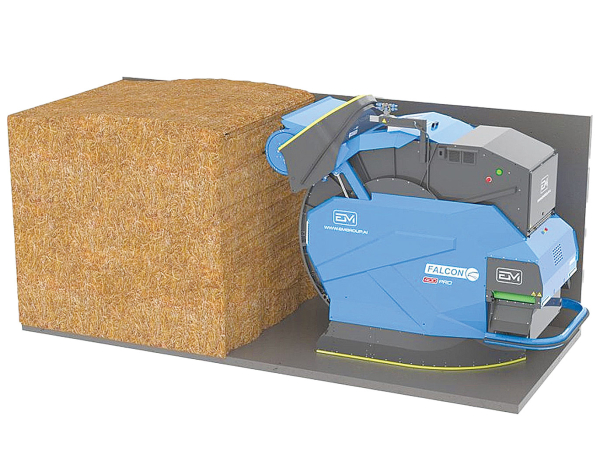
Recently previewed at European trade fair, the Polish manufacturer was showing the Falcon 400 Pro feeding robot- a fully electric and autonomous machine that can cut and load silage from a 3.0m tall clamp.
The 4.0 cubic metre capacity mixing tub is equipped with six paddles and eight knives that mix and cut the feed, with the company suggesting that the configuration is faster and requires less power than a small vertical mixing auger.
In addition to loading clamp silage, the milling head can also fill the tub with baled straw and hay. Complemented by a hatch at the top of the mixing drum is a hatch where concentrates and minerals can be added.
Depends on the forage material and travel distances, the robot is said to be capable of mixing and feeding up to 18t a day, which the manufacturer reckons is sufficient to feed up to 350 cows.
Robot navigation is taken care of by RTK connected GPS, with obstacles being detected by a 3D camera, operating in combination with ultrasonic sensors. Pneumatic bumpers are fitted around the machine perimeter, in addition to strategically located emergency stop buttons.
At 3.5m long and 1.5m wide, the vehicle requires a feed passage with a minimum width of 2.5m., allowing feed to be distributed to the left and right, via and unloading belt with a 90cm discharge height.