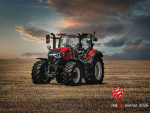
Case IH Unveils Next Generation Puma Series Tractors
Case IH has unveiled its redesigned next generation Puma Series tractors, said to offer improvements in connectivity, operator comfort, fuel efficiency and drivability.




 increase font size
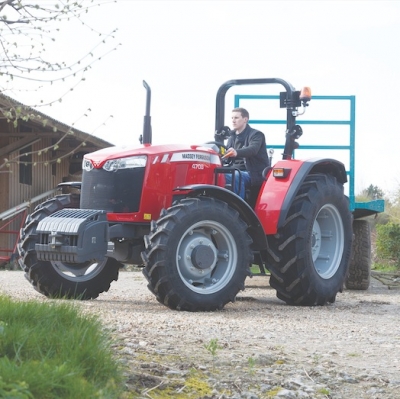 Massey Ferguson
Massey Ferguson has launched the first new tractors in its new Global Series. The tractors were shown for the first time in New Zealand at the recent Northland field days.
The MF4707 and MF4708 are the first new models in a new 74hp to 82hp range. These are the initial tractors in a new Global Series that will eventually offer three ranges, four different transmissions and be available in footstep, semi-platform and cab versions.
“It’s taken the best brains in Massey Ferguson to design and build this brand new range of workhorse tractors. These state-of-the-art tractors are the result of a $350 million investment in a completely new, clean sheet design,” says Simon Hole, director marketing.
“The Massey Ferguson Global Series has been designed and built in the 21st Century and is purpose-built for modern applications. While using the very latest, advanced engineering and manufacturing tools and techniques, they still retain our traditional straightforward operation, dependability and value for money.”
Hole adds that, where possible, the company has used existing design technology and components from our recently successful ranges, which are not only specially developed for the modern era, they allow us to provide local parts and service most efficiently across our whole range of tractors, wherever they are in the world.
He says more than 90% of the parts and components in the Global Series are entirely new - designed and engineered specifically for the tractors. Combined laboratory and field testing has reached over 36,000 hours and, reflecting the global nature of the new machines, prototypes have been tested in brutal conditions from Arizona in the USA to Lusaka in Zambia.
Case IH has unveiled its redesigned next generation Puma Series tractors, said to offer improvements in connectivity, operator comfort, fuel efficiency and drivability.
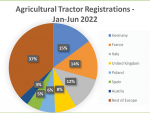
A total of 108,800 tractors were registered across Europe in the first six months of 2022, with 31,900 tractors of 37kW (50 hp) and under and 76,900 of 38kW and above.
Choosing the right new vineyard tractor is an important decision, given the major capital outlay.
Recently released in Europe, with expected delivery yet to be confirmed for New Zealand, the new Valtra A series tractors see a range of new transmission options that will get those looking for a compact workhorse.
New Zealand tractor sales finished 2020 on a strong note, with December sales up 18.4 % on 2019.


Alliance is calling for final applications for its 2027 Graduate Programme, with applications closing on Sunday 25 October.
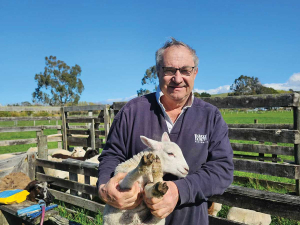
Decades piloting planes has ensured vet and farmer David Hayes is focused on safety. So, after a serious accident while welding on farm, he is sharing his experience so others can learn from it.
Canterbury milk processor, Synlait Milk has confirmed Leon Fung as its chief executive officer.
OPINION: Making it easier to collect rainwater and use it to grow crops and livestock is a no brainer.
As part of its Election 2026 coverage, Rural News asked political parties how they would help pull the arable sector out of the doldrums. Here's what they said:
Farmers are being encouraged to rethink how they manage waste on farm with the launch of ruralwastesorted.co.nz, a new website bringing together practical tips, real farmer experiences and resources.


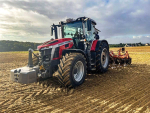


OPINION: The same mainstream media muppets that brought you Jacindamania in 2017 have been flat out pimping for the Opportunities…
OPINION: Your old mate reckons the atrocious way farmers in the UK are treated by their lords and masters in…




