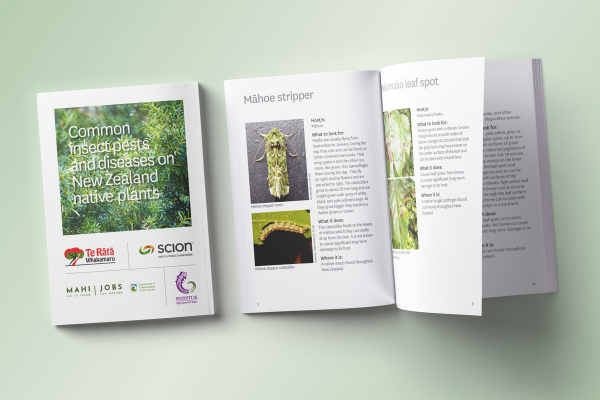
A booklet produced in 2025 by the Rotoiti 15 trust, Department of Conservation and Scion – now part of the Bioeconomy Science Institute – aims to help people identify insect pests and diseases.
The booklet, ‘Common insect pests and diseases of New Zealand native plants’, helps protect indigenous plant health. It can be used to help educate people about plant diseases, allowing them to broadly identify what insect pests and diseases they may come across.
New Zealand’s native species have a range of insect pests and diseases associated with them. Many of these are native, common and not known to cause significant damage.
The booklet can help readers separate these common diseases from potentially new diseases – such as myrtle rust or kauri dieback – that could damage native trees.
Each insect pest and pathogen is described in detail, with large photographs to make identification easy. A glossary with the Māori and scientific names of insect pests, diseases and host plants is included.
The booklet was a result of Te Rātā Whakamaru, a collaborative programme between Scion, Rotoiti 15 trust and the Department of Conservation funded by Jobs for Nature.
The programme’s role was to create jobs that supported nature. Te Rātā Whakamaru established roles for surveying and monitoring myrtle rust in the Bay of Plenty and sought to identify possible disease-resistant ramarama and rōhutu plants for the propagation of resistant planting material.
Any suspected new diseases or pests should be reported to the Ministry of Primary Industries on 0800 80 99 66 or at https://report.mpi.govt.nz/pest.