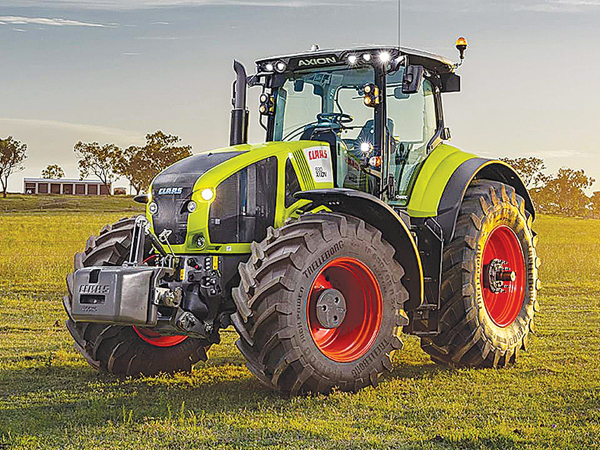
Claas has marked the 20th anniversary of entering the global tractor market with the production of its 200,000th tractor at its French Le Mans facility.
Having acquired a majority stake in Renault Agriculture in March 2003, the company signalled its intention to become a full-line farm machinery manufacturer. Within six months, Claas’s familiar seed green livery started to roll off the production line, manufacturing the Renault-based Celtis, Ares and Atles series.
The company then released its first series – the Axion 800 – just three years later, followed by the production of the Arion 600/500 series in 2007 and the Axion 900 series in 2011.
Claas now manufactures more than 35 different models spanning 75 to 530 hp across six series. This includes the Axion (205 to 445 hp), Arion (90 to 205 hp) and Axos (75 to 102 hp) series manufactured at its Le Mans factory. This is in addition to the Xerion (462 to 653 hp) series, which is manufactured at the company’s headquarters in Harsewinkel, Germany.
Each series features a distinctive, compact shape, long wheelbase and low centre of gravity for optimal stability. They have balanced weight distribution over the front and rear axles for optimal traction, a narrow waist for maximum steering lock and manoeuvrability and a relatively high unladen weight to reduce the need for ballast.
The tractors have earned a string of international accolades for innovation. The Axion 900 and 800 models both winning Machine of the Year awards at Agritechnica, Europe’s largest agricultural technology exhibition. In addition, the Axion 800 was named the 2014 Tractor of the Year.
In 2017, Axion 960 Terra Trac was awarded a silver medal for innovation at Agritechnica. Recently, a top-of-theline Axion 960 won the Most Sustainable category of the 2021 Tractor of the Year awards.
Claas Harvest Centre Product Manager – Claas Tractors, Paul Holdaway, says, the Claas Power Systems concept aims to optimise every component of the drive train. “The engine, emissions control, transmission, drive assembly, PTO shaft, axle, hydraulics and management systems.”
Claas has invested heavily in its tractor research, development and manufacturing capabilities during the past two decades. These have included a major redevelopment of its tractor manufacturing facility at Le Mans, France; the construction of a state-ofthe- art testing and validation facility in Trangé, France; and the construction of a new transmission manufacturing plant in Paderborn, Germany.
Le Mans is recognised as one of most modern vehicle manufacturing sites in Europe.
It has the capability of producing more than 60 different models at the same time, from low specification tractor right up to the advanced Axion 900 Terra Trac.
The Trangé research and development site is used to develop and assess the next generation of tractors. This facility works around the clock with a team of more than 60 researchers testing engine, transmission, suspension, hydraulics and management systems under simulated working conditions. Pre-production models undergo up to 40,000 hours of fieldtesting before commercialisation.