What Would Synlait Be Worth to Fonterra or a2 Milk?
Speculation of a possible joint move by Fonterra and a2 Milk to buy Synlait raises a much bigger strategic question, says agribusiness expert Dr Nic Lees.




 increase font size
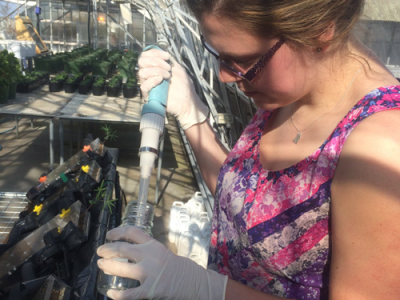 Lincoln University PhD candidate Amy Whitley.
An innate curiosity for 'why things happen' made Lincoln University PhD candidate Amy Whitley a natural fit for scientific research.
Now she's using that curiosity to improve New Zealand's soils and raise the productivity of low fertility land in hill and high country areas.
Thanks to Lincoln University and Ballance Agri-Nutrients, Amy is taking full advantage of an opportunity to pursue a doctoral study in soil science, a field she is passionate about and believes holds vital importance to both the local and global economies.
"Soils acidify over time, through natural weathering and land use," explains Amy. "This affects their utility for agriculture and reduces overall productivity – essentially reducing the amount of food we can grow and produce.
"This is not just a New Zealand problem but also a global one too and it isn't going away by itself, so we need to research the issue and find ways to address it."
Her research is part of a body of study that looks into the known association between acidic soils and aluminium toxicity, which affects the growth of plant species and in particular legumes such as clover and lucerne. Legumes are critical to the economic viability of New Zealand sheep and beef production.
"By identifying the key drivers of aluminium toxicity and the relationship with soil pH and other soil characteristics, we can determine the areas that are most susceptible to aluminium toxicity and the resulting low productivity," says Amy.
"This research will help to inform better land use decisions – such as where best to apply fertiliser and lime to get optimal soil productivity and also which mitigation strategies will be most effective."
Despite growing up in urban environment Amy enjoys going out onto farms and says some of the best parts of her research involve getting out into the field and meeting the farmers her research will help most.
"It's hard to complain when the field sampling requires me to travel to some of the most beautiful parts of New Zealand," says Amy. "The farmers we talk to are generally very well informed and know what we're trying to achieve; it's great to know they are interested and supportive of our work."
Amy's research position at Lincoln University is one of many sponsored by farm nutrient co-operative Ballance Agri-Nutrients, who contributed $350,000 last year to support six doctoral candidate positions.
Ballance's science strategy manager, Warwick Catto, says the two organisations share a key focus in advancing soil research to drive innovation that lifts on-farm productivity.
"The cutting edge research being carried out by Amy and her colleagues should deliver key insights on how best to prioritise fertiliser and lime inputs to areas of low fertility that are most prevalent in hill and high country regions. The economic and productivity impact will be huge from prioritising the right lime and fertiliser spend to the right soils and landscapes," says Warwick.
"We're excited to support doctoral research at Lincoln University as part of our wider research and development programme, and are encouraged that bright minds like Amy are passionate about advancing soil research in ways that will generate tangible improvements for both our farmers and primary industries as a whole."
Speculation of a possible joint move by Fonterra and a2 Milk to buy Synlait raises a much bigger strategic question, says agribusiness expert Dr Nic Lees.

Lynnette Hudson's 30-year obsession with Pinot Noir was sparked working vintage in Burgundy, seeing how subtle changes in terroir were expressed in the glass. It was, she says, "an elightening moment in every way".
A four year trial has reaffirmed that mixing plantain into dairy pastures can help reduce nitrogen losses to freshwater while maintaining milk production and profitability, say researchers.
Twenty five secondary school students from around New Zealand recently completed a three day residential programme designed to explore career opportunities across the food and fibre production supply chain.
A Lincoln University student is set to become the first person to contest both the Young Viticulturist and the Young Winemaker national titles in one year.



Federated Farmers has welcomed new rural policies released by ACT, saying they align closely with its own election priorities.

Rural Contractors NZ says proposed changes to land transport rules for agricultural vehicles are a welcome response by the Government to out of date regulations which have seen members hit with huge fines.
Alliance is calling for final applications for its 2027 Graduate Programme, with applications closing on Sunday 25 October.
Decades piloting planes has ensured vet and farmer David Hayes is focused on safety. So, after a serious accident while welding on farm, he is sharing his experience so others can learn from it.
Canterbury milk processor, Synlait Milk has confirmed Leon Fung as its chief executive officer.
OPINION: Making it easier to collect rainwater and use it to grow crops and livestock is a no brainer.





OPINION: The same mainstream media muppets that brought you Jacindamania in 2017 have been flat out pimping for the Opportunities…
OPINION: Your old mate reckons the atrocious way farmers in the UK are treated by their lords and masters in…




