New Rural Recycling Scheme to Replace Voluntary Farm Plastics Programmes by 2027
Environment Minister Nicola Grigg has announced details of a new rural plastics recycling scheme.




 increase font size
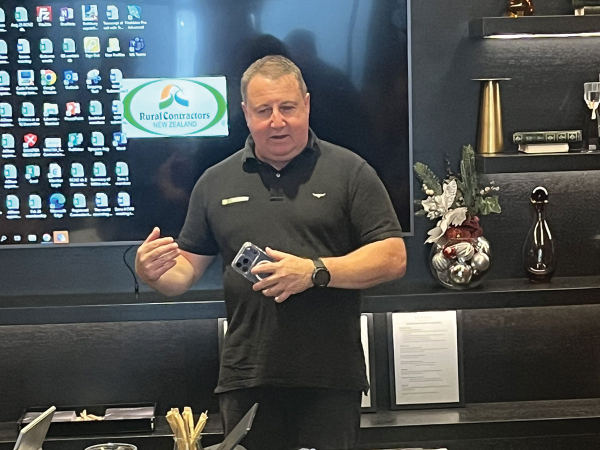 Agrecovery chief executive Tony Wilson speaking at a Rural Contractors NZ board meeting last month.
Rural contractors will be able to play a role in the revamped agricultural plastic recycling scheme with new regulations due for Cabinet signoff before this year’s election.
Agrecovery chief executive Tony Wilson told February’s Rural Contractors NZ board meeting that there would be opportunities for its members to collect plastic waste from farmers, either through charging or as an add-on to their service.
“The plan is that the market will build competition.”
Currently farmers can buy a collection bin from commercial company Plasback and then pay $50 per liner bag for its removal of what is principally sileage wrap; farmers can also dispose of the bags themselves at approved sites for $30.
Last December, the Government announced the industry-led scheme which will bring the Agrecovery and Plasback programmes together into a single national system for all users of agrichemicals and farm plastics. Agrecovery, which is a not for profit, will manage the scheme.
This will cover key farm plastics including agrichemical containers and drums, bale wrap and silage film, small bags used for agricultural products and bulk woven polypropylene bags.
Wilson says the new regulations now being drafted propose to provide free plastic disposal for farmers at up to 120 sites around the country. Some would be permanent but others will be ‘event’ locations where farmers could take their plastics for a few weeks to a site run by an organisation such as a local Lions club.
The new scheme will be funded by a fee paid by producers on four waste streams – bale wrap and silage sheets, small plastic bags, large woven polypropylene bags and agrichemical containers.
No Rogue Players
Part of Agrecovery’s new responsibilities will be ensuring that there are no rogue players selling wrap without paying the fee.
Currently about 12,000 tonne of sileage wrap alone enters the NZ market. The fee will be about 50c for a bale of film or wrap.
Agrecovery chief executive Tony Wilson says currently Agrecovery and Plasback costs total around $8m a year which sees about half of annual agricultural plastic use recycled. The new scheme is estimated to bring in $12m with an aim over time of recycling 100% of plastic. The European Union is currently recycling 85% of its sileage wrap.
Most of the extra costs would involve the leasing of five or six trucks to move plastic from the 120 collection sites to two processing centres in Matamata and Christchurch.
These sites will wash, shred and bale plastic for offshore recycling. Only properly accredited and audited recyclers will be used to ensure no child labour exploitation and that environmental standards are maintained.
Wilson says Agrecovery and Plasback have worked on recycling plastic for 20 years and the new regulations would provide the framework to develop a fully integrated rural recycling scheme.
He says the focus remains on making life easier on farm. He agreed with questions from the RCNZ board that some farmers didn’t want to currently pay for plastic collection, and burning it was still allowed by some regional councils.
RCNZ CEO Andrew Olsen said councils had a role to play, as did the Government, in ending such practices, and his organisation wanted to help ensure plastic, including that provided to farmers by its members, could be recycled.
Environment Minister Nicola Grigg has announced details of a new rural plastics recycling scheme.

The Government is introducing a new nationwide rural recycling scheme that will significantly increase the recovery of farm plastics from March next year, Minister for the Environment Nicola Grigg announced today.
Rural contractors are getting guidance on how to deal with recent rising fuel prices.
Rural recycling scheme Agrecovery is welcoming the Government's approval of regulations for a nationwide rural recycling scheme for agrichemicals and farm plastics.
The Government is calling on rural New Zealanders to share their views on proposed regulations designed to improve the management of farm plastic waste.


Farmers are being encouraged to rethink how they manage waste on farm with the launch of ruralwastesorted.co.nz, a new website bringing together practical tips, real farmer experiences and resources.

New Zealand Winegrowers (NZW) is celebrating the India-New Zealand Free Trade Agreement (FTA) coming into force today, bringing New Zealand wine improved access to one of the world’s fastest-growing economies.
New Zealand’s red meat sector has welcomed the India-New Zealand Free Trade Agreement taking effect, which removes India’s 33% tariff on New Zealand sheepmeat.
More than 95 per cent of New Zealand’s forestry and wood exports to India can now enter tariff free as the New Zealand-India Free Trade Agreement comes into force today.
Federated Farmers is backing Feilding High School’s call to keep Agriculture and Horticultural Science as a standalone subject in Year 11.
Food and fibre exports have returned a billion- dollar bonus to the country.



OPINION: The same mainstream media muppets that brought you Jacindamania in 2017 have been flat out pimping for the Opportunities…
OPINION: Your old mate reckons the atrocious way farmers in the UK are treated by their lords and masters in…




