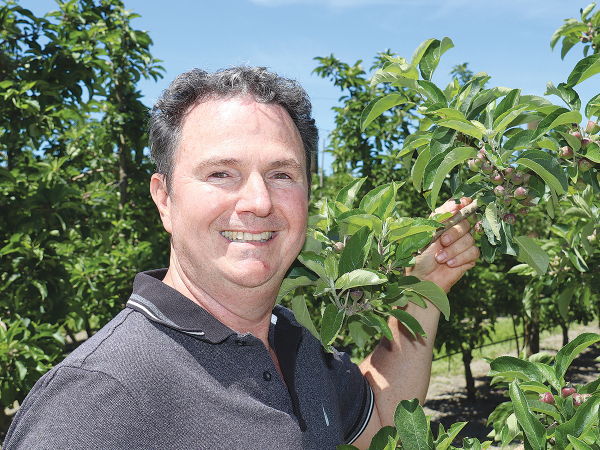
A Hawke's Bay apple grower says it's no longer profitable for him to export apples to the US because of the 15% tariff imposed on them by Donald Trump.
Paul Paynter of the Yummy Fruit Company says the tariffs cost him around two dollars per box of apples and that, he says, wipes out the profit.
He says the margins are not big enough to wear the cost of the tariff and on top of that, the market there is oversupplied with apples.
He says there are also problems in the UK and Europe.
"While the market there was pretty good, the shipping problems are not," he told Rural News.
"Our worst container took 107 days to arrive because you're sailing around Africa and it's just not good to be having fruit in a shipping container for that long. The cooling isn't great in those shipping containers and it's way too long to have product on the water. In the old days we were in Europe in 38 or 39 days," he says.
Paynter says the longer journey can result in quality problems as well as increased costs. He says the UK is not in good shape and while the exchange rate in Europe is a bit better, the problem won't be solved until they get the Suez Canal operating at capacity.
Read More:
"So, for the first time in our company's history we will only be exporting to Asia in the coming season," he says.
Paynter says 20 years ago they were virtually shipping nothing to Asia, but now things have changed and Asia, with shorter shipping time and easier time zones, coupled with economic growth in emerging markets, makes it a much more attractive export proposition.
Water Needed for Healthy Trees, Good Crop
Paul Paynter says last season was probably the best one since as far back as 1991, with a beautiful warm spring, virtually no frosts, good fruit size and high quality - all culminating in a high pack out.
He says the exchange rate was good and although the markets were mixed, they did well.
This season is different with a cold winter and spring running about a week later than the ten-year average. But high winds buffeted the trees and helped get the flowers open quickly.
Paynter says the spring has been good, but it's drying out and they were having to irrigate their trees in October - something they never had to do before.
"We got 20 mils a couple of weeks ago but the rainfall data shows it was low in September and October and will be low in November, but there was a decent amount of snow on the mountains, so hopefully we will get a decent supply of water in the rivers out of that melt," he says.
Now, Paynter is busy trying to estimate the size of his apple crop and says while they have a sophisticated empirical system for doing this, simple guess work is often just as good because the small apples are hidden under the leaves.
He says the main thing now is getting water on the crop, which is the major driver for healthy trees and a good crop.