
Where Is The Honesty Among Our Representatives?
OPINION: A founding principle of Groundswell NZ is that farmers, and people generally, should be provided with full and accurate information about regulations that directly affect them.




 increase font size
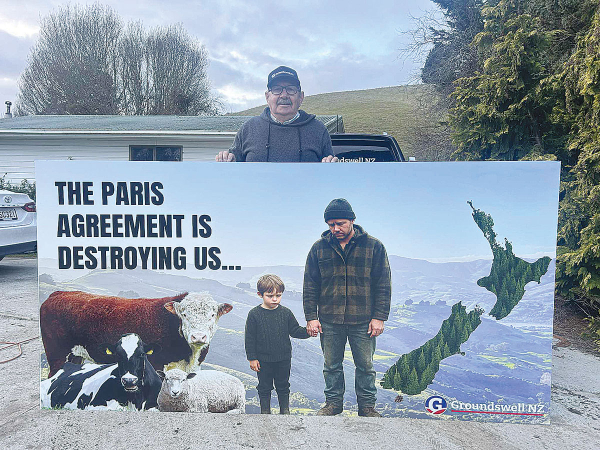 Groundswell co-founder Bryce McKenzie.
A drop in methane targets announced by the Government this month has pleased farmers but there are concerns that without cross-party support, the targets would change once a Labour-led Government is voted into office.
Groundswell co-founder Bryce McKenzie says it’s great to see methane targets “now aligning more with the science”.
“But if it were to be based on not adding to global warming, then of course the target should be zero,” he told Rural News.
He adds that it’s always a worry that a new Government will change everything “because of ideology rather than science”.
Beef + Lamb NZ chair Kate Acland says the revised targets better reflect the science around the different warming impact of short- and long-lived gases.
The Coalition Government has set a new range of 14–24% below 2017 levels by 2050, reflecting the findings of the independent Methane Science Review released in 2024. The previous target, set by Labour, was 24-47%.
Acland told Rural News that meeting the 24% target will be challenging for the red meat sector.
“The revised target doesn’t mean we’re getting let off the hook: meeting the upper end of the target will be really challenging.”
Acland adds farmer groups including B+LNZ have been talking to politicians across the spectrum so everyone to understand the science and science-based solutions to reducing emissions.
“The revised targets better reflect the science around the different warming impact of short- and long-lived gases. Methane should only be asked to do what is expected of other gases, which is to achieve no additional warming. New Zealand’s red meat is already among the most climate-efficient in the world, thanks to our pasture-based farming systems.”
Labour’s agriculture spokesperson Jo Luxton isn’t happy with the revised targets but concedes a Labour-led government wouldn’t go back to past ways of working.
“We didn’t always get it right in our last term of Government – we certainly wouldn’t go back to that way of working towards targets which is why we’ve indicated we would be open to bipartisan discussions to ensure consistency long term,” she told Rural News.
“Christopher Luxon rejected Labour’s request – which would have made parliamentary majority – to allow for infighting from Act and New Zealand First instead. We need to see the advice the Government based this decision on.
“By lowering our climate target, the Government is giving up on the export opportunities that come from leading the world on sustainable production.
“Instead of backing our strengths, they’re moving the goal posts. I’m disappointed this short-term thinking will weaken New Zealand’s climate targets - it’s bad news for Kiwi exporters and for New Zealand’s future.”
Meat processors describe the revised targets as sensible and more achievable.
Meat Industry Association chair Nathan Guy says the new targets are grounded in science and strike the right balance between lowering emissions and maintaining food production.
“Importantly, they give our international customers confidence that New Zealand remains committed to doing its part on climate change.”
The Government has also ruled out a tax on agricultural methane emissions.
Agriculture Minister Todd McClay says the Government approach is clear.
“Technology and partnership, not taxes, will deliver the reductions that we need. By investing in new tools and giving farmers practical support, we can cut emissions without cutting production or profitability.”
OPINION: A founding principle of Groundswell NZ is that farmers, and people generally, should be provided with full and accurate information about regulations that directly affect them.

OPINION: Groundswell's opinion of the incumbent farm industry representatives isn't high.
OPINION: Bouquets this week from the old mutt for Fed Farmers and Groundswell for continuing to resist the proposed Gore District plan and its intention to apply costly "cultural values" across the district and a raft of land classifications that are unworkable and counterproductive.
Three farmer lobby groups are applying the blowtorch to political parties on key issues facing the primary sector ahead of the general elections.
OPINION: Many sheep and beef farmers will be worse off under the new environment legislation than they were under the Resource Management Act (RMA), claims Beef+Lamb New Zealand (B+LNZ) in an email to levy payers.



The potato industry is celebrating the success of two rising stars - James Blair, the 2026 Young Grower of the Year and runner-up and innovation award winner, Amber Davy.
Twenty-eight emerging leaders from across the horticulture sector spent two days last month learning valuable skills and connecting with industry experts.
There are five entrants in this year’s Young Horticulturist of the Year, competing in a series of technical, practical, business and leadership challenges.
A seasoned horticulturist has been appointed to deliver the Apple Action Plan, a key initiative of the India-New Zealand Free Trade Agreement.
New Zealand's citrus growers have been told to compete on the value built into their fruit rather than the volume they grow.
Hawke's Bay fruit growers are being reminded of the need to prepare for whatever the El Niño weather system may bring in the coming months.





OPINION: The same mainstream media muppets that brought you Jacindamania in 2017 have been flat out pimping for the Opportunities…
OPINION: Your old mate reckons the atrocious way farmers in the UK are treated by their lords and masters in…




