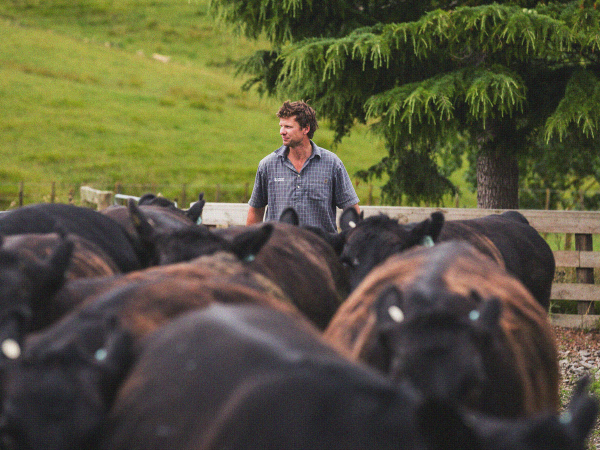
A Hawke’s Bay farm is seeing great results by giving their cows a ‘stress-free’ environment.
Matangi Angus Beef has been achieving marble scores on par with sought after Wagyu beef.
Most beef cattle raised in New Zealand experience a range of stressors every day, including loud farm dogs and restricted feeding.
Matangi Angus Beef is going against the grain, reducing stress on its herd at every touchpoint. This approach produces beef sought after for its butter taste and texture that melts at the touch of a knife.
The approach has seen the farm achieve a marbling score of 6 this season, with the beef sought after and served up by top chefs and food connoisseurs across New Zealand.
Farm manager Jamie Gaddum says the marbling score in beef is measured by the degree of visible intramuscular fat found within the meat and is directly related to the conditions experienced by stock, including stress.
“Marbling scores are expertly graded by an independent, qualified assessor, who bases the score on the rib eye muscle of each animal. Only a happy animal will eat consistently, so this and a nutritional diet will help produce those intramuscular fats,” Gaddum says.
Matangi’s stress reduction approach eliminates most common stress causes – extended trucking, changing environments, restricting feed, mixing cattle mobs up and using loud farm dogs.
“Stress produces lactic acid in the meat from the breakdown of glycogen, resulting in beef with a lower pH level, lighter colour, reduced water-binding capacity, and it’s tougher to eat. We’ve achieved pH levels consistently between 5.7 and 5.9 - which is considered optimum for the highest quality meats. We also feel good knowing we are providing our herd with the best conditions on-farm and the most stress-free life possible,” he says
“Everything we do, we have our consumer in mind, and I often think when doing a task on the farm that if one of our restaurant’s customers was to see me now, would I still do it this way? I make sure the answer is always yes. The wellbeing of our animals is paramount, and happy animals produce high-quality meat, so it’s a win-win.”
With consumers becoming more aware of where their food comes from, Gaddum says Matangi hopes to see the emergence of boutique producers that focus on quality and more farms adopting highly ethical and sustainable practices throughout the sector.