White Clover: Free Nitrogen as Urea Prices Climb
Growing great pasture this season doesn’t have to break the bank.




 increase font size
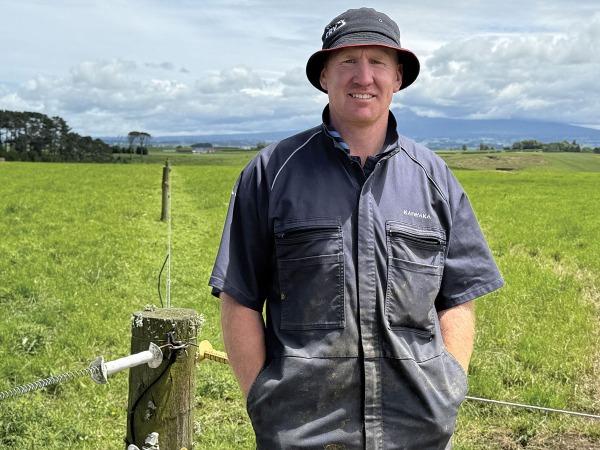 Hawera farmer Hayden Lawrence says pasture persistence is looking good, too, even after severe drought in 2024/25.
It may still be under the radar for many, but one new pasture has been making waves for three different farmers lately.
From Taranaki to Waikato, System 3 to System 5, year-round milking to spring calving, they've all gained more home grown grass and stronger businesses as a result.
Now in his fourth year with Array perennial ryegrass, Hawera's Hayden Lawrence says persistence is looking good, too, even after severe drought in 2024/25.
"We didn't have to do any undersowing with Array last season like we had to do in other paddocks."
Hayden and wife Alecia split calve 400 cows on 153ha (eff) for average annual production of 200,000 kg milksolids.
This is a System 3 farm; 15ha of home grown maize silage, annual ryegrass and 700 kg/cow imported feed supplement perennial pasture as needed throughout the year.
Hayden first tried Array as a hardier alternative to tetraploid perennials, and combined with a 'game changing' shift in pasture establishment technique, is very happy with the outcome.
"It's ticked those boxes in terms of production, heading date and longevity. We wanted something that would hold on - we were having issues with pasture pulling, partly because of how we were establishing our new grass."
Strip tilling maize, then mulching the stubble instead of power harrowing, followed by direct drilling new pasture, has now improved both soil quality and rooting depth.
The other thing he's noticed? "Array's quite a dense, bunched pasture. When cows take a mouthful, they're taking in a lot of feed!"
In Waikato, three years of measuring pasture at least fortnightly proved Array consistently outgrew other pasture by 100-200 kg dry matter per ha every grazing, Logan Dawson says.
He and his wife Sian split calve 600 cows on a System 5 at Taupiri. Array did so well on their previous farm, when they got the chanced to select new grass cultivars before starting here in June 2025, they picked it again.
Like Hayden, Logan notes Array's persistence, plus feed quality.
"In our previous system, we found because of its erect nature, we were able to graze at the fourth leaf without losing the first leaf onto the ground. We could put the cows in at a pre-graze cover of 4000 kg, pre-mown; the quality was really good and they milked very well on it."
Further south, Pirongia sharemilkers Sean and Katrina Gibson went all in on Array for the first time last autumn, sowing 12ha.
By November, it was all on an 18 day round, vs 25-26 days for the rest of the System 3 farm, where they spring calve 340 cows.
"Array is a different beast! The way it grows - you have to graze it early," Sean says.
A plate meter is essential, too. "You cannot tell how much is in there by eye. It's only when you get in there and measure it you see how dense it is. Array has forced everybody to change how they identify when a paddock is ready for grazing."
Article: Barenbrug
Growing great pasture this season doesn’t have to break the bank.
It's only just hit the market, but a new forage rape bred for dryland farms has already won the approval of lambs and young cattle both north and south.
Keeping cows happy and well fed at home this winter just got easier with the launch of a prolific new annual ryegrass bred to jump out of the ground even faster than its popular predecessor.
New industry trials confirm what matters most for perennial ryegrass seed this autumn: Cool, dry storage keeps endophyte viability above the 70% commercial threshold, according to pasture specialist Barenbrug.
Pasture specialist Graham Kerr claims that one hybrid ryegrass in New Zealand continues to dominate industry yield trials, as it has done every year since it was launched in 2021.

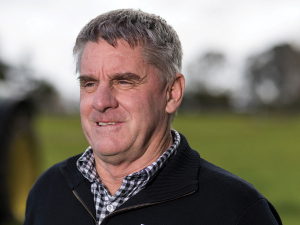
Federated Farmers has welcomed new rural policies released by ACT, saying they align closely with its own election priorities.

Rural Contractors NZ says proposed changes to land transport rules for agricultural vehicles are a welcome response by the Government to out of date regulations which have seen members hit with huge fines.
Alliance is calling for final applications for its 2027 Graduate Programme, with applications closing on Sunday 25 October.
Decades piloting planes has ensured vet and farmer David Hayes is focused on safety. So, after a serious accident while welding on farm, he is sharing his experience so others can learn from it.
Canterbury milk processor, Synlait Milk has confirmed Leon Fung as its chief executive officer.
OPINION: Making it easier to collect rainwater and use it to grow crops and livestock is a no brainer.


OPINION: It seems Canterbury processor Synlait is still in the doldrums.
OPINION: Get offside with New Zealand First leader Winston Peters at your own peril.




