Suzuki Launches Jimny Horizon
Suzuki New Zealand has announced the arrival of the latest version of its Jimny SUV, the Horizon special edition, a one-off for the local New Zealand market.




 increase font size
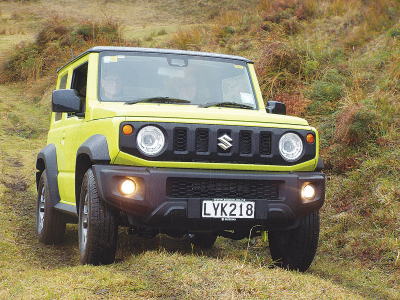 Suzuki’s latest Jimny.
The latest, fourth-generation Jimny “takes the best of the three previous generations and brings it bang up-to-date,” says Suzuki.
Anyone with an interest in off-roaders or small SUVs will know the Suzuki Jimny.
No surprise there, given it’s been around for 50 years, has evolved through three generations and has piled up sales of 2.85 million in 194 countries.
The latest, fourth-generation model retains the square body, original wheelbase and functional interior, but also has several driver support systems and the ‘must haves’ of modern motoring.
Tweaks to the body see it being 30mm shorter, 50mm taller and 45mm wider. The exterior profile has a more upright design at the A-pillars and a clamshell engine hood, both said to aid visibility; and a similar message is seen in the cut-away design at the front of the driver and passenger windows.
Inside the cabin, the dashboard is split into three levels, with simple yet informative instruments; the centre console is dominated by a 7-inch infra-red touch screen display. As you would expect, this display presents audio and navigation functions and, of course, the must-haves -- Apple Car Play and Android Auto.
The seats are 55mm taller, and are wider, with more cushioned and supportive frames; in the rear the split seats fold to a useful 1300mm wide x 980mm long load area, the seat rears covered with a plasticised material for easy cleaning.
The engine is a 4-cylinder unit of 1500cc that delivers 75kW (100hp) and 130Nm torque -- an increase on the old model; and while this may appear a moderate output, it proved to be remarkably capable during a brief off-road adventure at the media launch.
Transmission options are a 5-speed manual unit or a 4-speed auto, with a transfer case giving a genuine low range, selected by a stubby lever between the front seats.
The ladder frame chassis has two extra cross members and a robust X-member at the centre to increase torsional rigidity, and the body sits on eight rubber mounts said to enhance ride quality and comfort.
Three-link axle suspension with coil springs act on the solid axle which is upgraded to higher tensile steels.
The All-Grip Pro Drive system offers a choice of 2WD, 4WD and 4WD-Low that combines with a clever brake LSD/traction control function; this makes sure work of tricky terrain by using electronic brake control to prevent spinning wheels and redistribute torque to the wheels still on the ground. A hill hold/hill descent function prevents the vehicle from rolling back on climbs and restricts downhill speeds to 5 or 10km/h when 4WD or 4WD-low is selected.
As part of the standard package, a host of driver aids are right up there with the mainstream market: lane departure, weave alert, autonomous braking, auto headlights and six airbags.
Suzuki New Zealand has announced the arrival of the latest version of its Jimny SUV, the Horizon special edition, a one-off for the local New Zealand market.
While quads and LUVs are a major part of the rural landscape, on many New Zealand dairy farms 2-wheelers continue to be an important part of the logistics puzzle.
Since its launch in the late 1960s, nearly 3.5 million Suzuki Jimnys have been sold worldwide, picking up numerous awards along the way.
Fifty years ago, Suzuki was a pioneer in developing a small Sport Utility Vehicle (SUV) with fourwheel drive capability and low fuel consumption. Suzuki Development of the original Jimny in 1968 and the LJ10 Jimny arrived in 1970 it was the first mass production 4WD in the Japanese domestic mini-car category.
Suzuki was the first on four wheels right back in 1982, when Suzuki importer of the day Rod Coleman developed the successful LT125.



National’s much-touted free trade deal with India featured in the Rural Issues Debate at Mystery Creek, Hamilton on Wednesday night.

New Zealand's 2026-27 freshwater fishing season has opened, with anglers encouraged to head to rivers and lakes over the coming days as conditions look favourable across much of the country.
Central Otago District Council (CODC) has voted against a plan to spread treated sewage sludge from Cromwell and Alexandra on farmland near Lauder, a decision Federated Farmers says reflects strong opposition from rural residents.
Pāmu has released its FY26 Integrated Annual Report, reporting a Net Operating Profit of $113 million, more than double the $49 million recorded in FY25.
Meat Industry Association data, released alongside the Red Meat Sector conference in Wellington, shows export value climbing across the US, China, UK and Canada.
Applications are set to open for the 2027 Zanda McDonald Award, a trans-Tasman award recognised for identifying and fast-tracking talented young leaders in agriculture and agribusiness.


OPINION: It seems Canterbury processor Synlait is still in the doldrums.
OPINION: Get offside with New Zealand First leader Winston Peters at your own peril.