
Where Is The Honesty Among Our Representatives?
OPINION: A founding principle of Groundswell NZ is that farmers, and people generally, should be provided with full and accurate information about regulations that directly affect them.




 increase font size
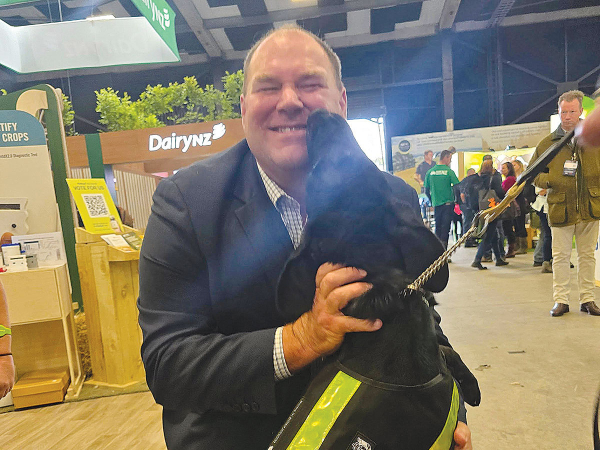 Biosecurity Minister Andrew Hoggard with a MPI detector dog at Fieldays.
"We're trying to get to the promised land but we're still in a bit of a swamp at the moment."
That's Associate Agriculture Minister Andrew Hoggard's response to ongoing farmer frustration around implementation of regional plans.
Hoggard says the Government is working to get better regulations in place, but the situation isn't helped by some regional councils ploughing ahead under the old system.
He says these councils don't recognise the work being done by the coalition Government to change the rules.
"I don't know - do they feel too afraid that environmental activists and lawyers would take them to court if they don't keep pushing this stuff through?" Hoggard told Dairy News.
Getting consent renewals remains a big issue for many farmers. Hoggard says some renewals were just not being issued for unknown reasons, and a small group of extensive farmers risked being placed into a costly notified consent, just so they could carry on farming.
The costs that some of these landowners are being put through is eye watering, he adds.
He says changing the rules takes time and he hopes that regional councils can hold fire and wait until the new rules and regulations are in place.
"Let us get the new rules and regulations in place and then you can start moving on this stuff again, knowing that in all likelihood a lot of the heavy-handed rules and regulations will be gone."
Federated Farmers local government spokesperson Sandra Faulkner says councils can save money by sticking to their lane and leaving climate policy to central government.
"Councils should stop duplicating effort, and wasting ratepayer dollars, by setting climate policies."
Federated Farmers supports RMA and local planning reform that reduces delays, costs and uncertainty, and utilises tools like farm plans rather than consents, she says.
Meanwhile, Hoggard says he was happy to see the positive vibe among farmers at Fieldays.
He says dairy farmers are buoyant with a $10/kgMS milk price last season and a potential consecutive $10 payout this season.
However, he adds that farmers have concerns around geopolitical issues like wars and spats around tariffs.
"We've got a really volatile world at the moment, so things could change, but I'm hoping that common sense will prevail and we can keep doing well in the agriculture sector," he says.
"Because it's almost a universal positive story across the board for a wide range of our agricultural products: that's what this country needs - strong agricultural performance to move the economy forward."
OPINION: A founding principle of Groundswell NZ is that farmers, and people generally, should be provided with full and accurate information about regulations that directly affect them.
OPINION: Well, the silly season is upon us and all us politicians are running around shaking babies and kissing hands, or maybe the other way around.
It was billed as a chance for all the political parties to woo the rural vote, but question marks hang over just how effective this was.
There's been widespread support from the primary sector for the Government's announcement on changes to freshwater farm plans that come under the Natural Environment Bill, which is now set to replace the existing RMA.
Agriculture Minister Todd McClay has admitted that a scheme bringing workers from Pacific nations to work on orchards has become too hard to navigate but says changes are coming.

The Royal New Zealand College of General Practitioners (the College) and Hauora Taiwhenua Rural Health Network are calling for investment in a proposed new training pathway for rural GPs, warning that many rural practices are struggling to recruit while a large share of the existing workforce nears retirement.
Federated Farmers has called on Central Otago District Council (CODC) to drop or vote down a plan to truck sludge from Alexandra and Cromwell to farmland near Lauder, warning it would compound an "outrageous" situation created by a separate council's decision weeks earlier.
Synlait has swung to second-half profit as operations stabilise, but the dairy processor still posted a $75.4m annual loss.
LIC shareholders have elected a new North Island representative to the co-operative's Board, along with five representatives to its Shareholder Reference Group (SRG), following the company's Annual Meeting held in Invercargill.
Farmers across parts of Southland and South Otago are continuing to deal with difficult conditions after a prolonged run of wet weather, with pressure building around feed supply, stock management, pasture damage, farm infrastructure and everyday workloads.
Federated Farmers says it welcomes Labour's commitment to reviewing the Sharemilking Agreements Act, calling on other major parties to do the same.


OPINION: It seems Canterbury processor Synlait is still in the doldrums.
OPINION: Get offside with New Zealand First leader Winston Peters at your own peril.