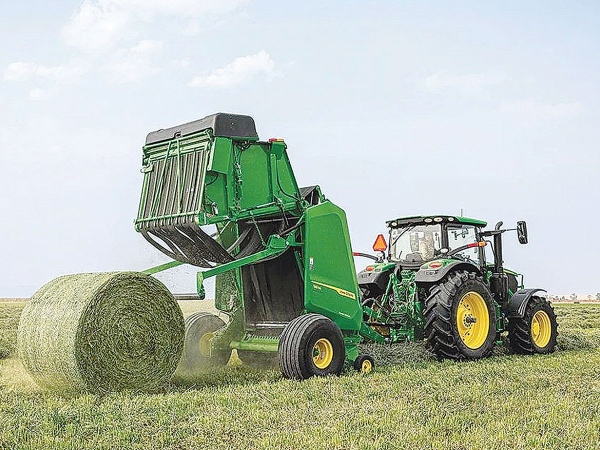
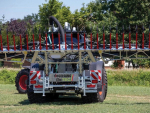
John Deere have recently announced upgrades to its round baler offerings, with all models of this latest generation equipped with advanced ISOBUS capabilities, allowing them to be fully integrated into the John Deere Operations Center.
While some digital innovations might appear frivolous for everyday farming, it would appear that some upgrades do add some utility to the machines.
Anyone who has spent time on a tractor seat will know the importance of a well-formed swath – ideally box-shaped and flattopped – ahead of the pick-up assembly. If the swath is significantly narrower than the pick-up, the operator will have to “weave” to fill the chamber uniformly.
JD’s innovative weave automation feature was first introduced in the US in February. Rather than driving to the left or right of the windrow for several metres, before switching to the other, a flexible drawbar automatically guides the baler left and right along the windrow, depending on how the chamber is filling.
The automated weaving feature is said to ensure consistently shaped bales, while also enabling the machine to accurately follow curved windrows, even at the field corners as it tracks the cut grass, eliminating missed crop and reducing tractor shunting. Additionally, the tighter turning radius makes general manoeuvring easier.
Two variable chamber models – the V452R and V462R – have been given a 15% increase in driveline power intake, offering a claimed 8% increase in productivity in the paddock, while the double-belt system has been upgraded to give 7% more compression.
The fast bale release system also allows for unloading a bale and closing the gate in just three seconds.
An optional moisture monitor can measure the average moisture per bale in real time and alerts the operator on the tractor display if the moisture content deviates from the pre-defined setting.
For those being asked for production and crop data – typically contractors – the ability to track each bale’s size and drop location data can be documented in the cloud, delivering the ability to record total bales per field and create dry-matter maps.
Combination baling and wrapping models, the C442R, C452R, and C462R, can be specified with a built-in bale weighing system, using strain gauges on each of the four transport table rollers, allowing on-thego measurement of individual bale’s weights.