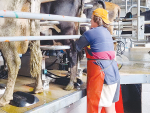
Semi-robotic milking technology to boost parlour efficiency
Waikato Milking Systems’ latest innovation, ErgoPOD is now commercially available within New Zealand and Australia.




 increase font size
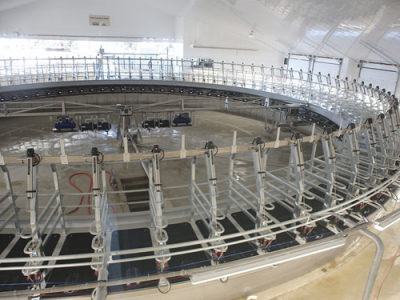
The first 84-bail composite Waikato Milking Systems rotary platform built in the US has won an energy efficiency award.
Cow Pleasant Dairy, owned by Tom and Katrien De Vos, Isabella County, Michigan, was named Large Business of the Year by Consumers Energy, the electricity and natural gas utility in Michigan.
Originally from Belgium, the De Vos family set out to innovate in developing their 3450 cow dairy; notably they chose to install the WMS rotary.
Tom De Vos said “we liked the concept of a composite platform which is extraordinarily strong yet light, easy to keep clean and energy efficient”.
The set-up has the maker’s SmartECR, SmartPuls, SmartLink and SmartWash systems, and electronic milk meters, auto sorting and herd management technology.
The dairy also has a direct-load milk cooling system which cools milk from 95oC to 36oC before it goes to a trailer parked outside the parlor; this removes the need for a bulk milk tank. When full, the trailer is taken to the processor and an empty trailer takes its place.v
De Vos says the system is efficient system, has minimal risk of bacteria, preserves the quality of the milk and cuts water use.
These and other features including fans which cool the cows and LED lighting led to the company being named the Large Business of the Year with energy rebates worth more than $US117,000.
Waikato Milking Systems’ latest innovation, ErgoPOD is now commercially available within New Zealand and Australia.
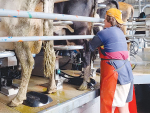
Waikato Milking Systems has unveiled the final production version of its ErgoPOD, a state-of-the-art semi-robotic technology designed to increase milking speed, productivity, and efficiency in the parlour.
While Waikato Milking Systems is committed to solving the challenges dairy farmers face with some of the world’s most innovative and technologically advanced dairy solutions, their approach differs from other companies, as their focus falls on retaining the essence of dairy farming.
Numedic Ltd has acquired a major part of Waikato Milking Systems' effluent and environmental business, including the well-known Cobra range of travelling rain gun irrigators.
OPINION: In the heartland of rural New Zealand, Waikato Milking Systems is on a transformative journey that seeks to revolutionise dairy farming practices with their latest innovation, ErgoPOD.


Farmers are being encouraged to rethink how they manage waste on farm with the launch of ruralwastesorted.co.nz, a new website bringing together practical tips, real farmer experiences and resources.

New Zealand Winegrowers (NZW) is celebrating the India-New Zealand Free Trade Agreement (FTA) coming into force today, bringing New Zealand wine improved access to one of the world’s fastest-growing economies.
New Zealand’s red meat sector has welcomed the India-New Zealand Free Trade Agreement taking effect, which removes India’s 33% tariff on New Zealand sheepmeat.
More than 95 per cent of New Zealand’s forestry and wood exports to India can now enter tariff free as the New Zealand-India Free Trade Agreement comes into force today.
Federated Farmers is backing Feilding High School’s call to keep Agriculture and Horticultural Science as a standalone subject in Year 11.
Food and fibre exports have returned a billion- dollar bonus to the country.


OPINION: It seems Canterbury processor Synlait is still in the doldrums.
OPINION: Get offside with New Zealand First leader Winston Peters at your own peril.




