Resilient Global Dairy Industry Overcoming Volatility
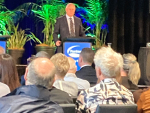
Fonterra chief executive, Richard Allen says being resilient has helped the dairy industry overcome extreme volatility in recent years.




 increase font size
 Architect's impression of the new IQF mozzarella plant at Clandeboye.
A new $240 million mozzarella plant announced today will double Fonterra’s capacity to produce its revolutionary individually quick frozen (IQF) mozzarella.
This will make Fonterra Clandeboye the largest producer of natural mozzarella in the Southern Hemisphere.
Robert Spurway, chief operating officer global operations, says demand for this mozzarella out of China and wider Asia continues to grow as more consumers seek out natural dairy products.
“This new plant, like the two before it, uses patented technology to produce a high quality, natural mozzarella without using chemicals in the production process,” says Spurway.
“It is the only process of its kind in the world that can significantly reduce production time while still remaining 100% natural – something our customers and their consumers place great value in.”
“It is one of our key product differentiators and has helped make mozzarella one of the most in-demand of our foodservice products. Once this expansion is complete, Fonterra’s mozzarella sales will have increased by more than 60% since 2008 when the first IQF plant was built,” he says.
The world-class innovation behind the IQF mozzarella reduces the processing time from three months to just six hours, and is one of the cooperative’s most tightly-kept secrets.
The technology, developed by the Fonterra Research and Development Centre, has been supported by Transforming the Dairy Value Chain – a Primary Growth Partnership (PGP) programme between the Ministry of Primary Industries, Fonterra and DairyNZ.
Spurway says prioritising these types of value add investments is central to the cooperative’s strategy.
“Driving strong returns will always be at the heart of our business and turning our farmers’ milk into higher value products is key to this. At the same time, we are required to accept and process all milk which has meant we have needed to focus on capacity first rather than always investing in the highest value products,” he says.
“While the need to keep pace with milk volumes has certainly had an impact on how we invest, we have not sat back from our commitment to keep pushing milk up the value chain.
“We have continued to back ourselves through savvy investment in the right products, the right innovations to differentiate our products, and the right people to engage our global customers and sell them on pure New Zealand dairy.”
The new expansion will capture every cent of value from the milk. New plants will process the whey and lactose created in the cheese making process – both valuable dairy ingredients. A new wastewater treatment plant will ensure the plants operate sustainably.
Fonterra chief operating officer global consumer and foodservice Jacqueline Chow says Fonterra’s IQF mozzarella is already topping more than half the pizzas in China and continues to grow.
“Forty per cent of people in urban China now eat at Western style fast food outlets once a week, and the use of dairy in foodservice has grown by over 30% in just five years.
“We see massive growth potential and our teams in the market are continually working to grow this valuable part of the business as we work towards foodservice becoming a $5 billion business by 2023.
“This new plant will go a long way to helping us achieve this. Our foodservice investments are always based on demand so it’s good to see this one follow so close behind last year’s expansion,” says Chow.
Work has already begun on the expansion, with the first product destined for markets due to come off the line in September 2018. More than 1,000 people will be involved in the project during this time, with the plant creating full time employment for 100 people in and around South Canterbury.
Fonterra chief executive, Richard Allen says being resilient has helped the dairy industry overcome extreme volatility in recent years.

Northland farmer Greg Collins has taken over as chair of the Fonterra Co-operative Council.
Fonterra’s 2026 financial year was a year of delivery, with record volumes of milk collected, processed and shipped by the co-op.
Dairy farmers, still holding onto their Fonterra shares despite switching milk supply elsewhere or exiting the industry, now face a stricter share sell-down requirement.
Milk powder prices are continuing their merry run, firming up a potential $10/kgMS farmgate price this season.

Halter has launched Mav, an AI farming assistant that lets dairy farmers ask questions about their herd and pasture and get answers drawn from the data the company’s collars already collect.

OPINION: At first glance it appears that Father Christmas has delivered the rural sector good tidings, with most pundits predicting the return of the centre-right coalition.
For 15 years, Glenda Rees has travelled from Gore to Awarua, often several times a week, to keep watch over one of the country’s rarest birds.
With some farmers opposing a government-industry partnership set up to develop methane reducing products, one NZ company claims that it already has a product on the market.
During the nesting season, from September to December, industrious starlings can quickly build nests in the darker areas behind tractor and vehicle, usually close to hot engines, typically resulting in localised damage or in some cases complete write-offs.
The meat processing industry is much more collegial than it was in the past and is now more focused on common goals.
OPINION: It seems Canterbury processor Synlait is still in the doldrums.
OPINION: Get offside with New Zealand First leader Winston Peters at your own peril.