
Federated Farmers Welcomes ACT’s New Farming Policies
Federated Farmers has welcomed new rural policies released by ACT, saying they align closely with its own election priorities.




 increase font size
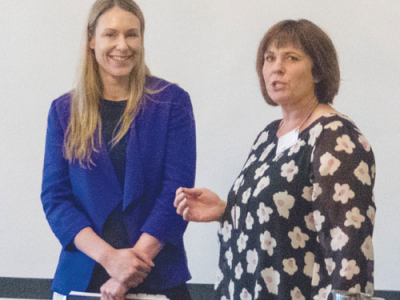 Federated Farmers West Coast dairy chair Renee Rooney (right) and NAIT chief executive Michelle Edge at the meeting.
The National Animal Identification and Tracing (NAIT) system has provided MPI investigators of the Mycoplasma bovis outbreak with nearly 1000 reports since the disease was identified last July.
At a time when farmers’ non-compliance with NAIT is blamed for making MPI’s response much harder than it should be, NAIT chief executive Michelle Edge is defending the system as “philosophically well-designed”.
“The system has functioned as it needed to, where the data was in it and where farmers have kept their accounts up to date. We’ve been able to trace stock.”
Edge spoke in a closed session to a recent Federated Farmers dairy and sharemilkers’ combined council meeting in Christchurch.
Interviewed later, she said provisions for enforcing farmers’ compliance were available in the scheme.
“I think further application of compliance needs to occur but there’s definitely some need for farmers to be diligent around their requirements.”
Two committees have been steering a review of the system and are near finalising their recommendations. Consultation will follow but the timing will be in MPI’s hands, said Edge.
“I can’t give any specifics yet but I can say that there are recommendations associated with the identification of livestock, how movements need to be recorded, and the roles and responsibilities of various players involved in the system.
“There’s obviously a focus on compliance and what’ll be applied there.
“The one message I want to give is essentially that the system of traceability – having to tag an animal, register it, register your premises and register your movements... those philosophical elements are unlikely to change because that is the basis of any system in the world.”
But clunky software gets in the way
Feds dairy section chair Chris Lewis said NAIT chief Michelle Edge took lots of questions from council members at the Christchurch meeting.
It was good to get the questions asked and answered, he said. Lewis said NAIT must be changed to make it more user-friendly.
“We’re in the 21st century now. We want iPads and apps.”
“At the moment NAIT software’s quite clunky and that’s why people get frustrated. Do I need to keep two or three software programs for herd records? Or is there one which talks freely with the main provider? If the system’s easy to use, farmers will comply.”
At the start of the meeting Lewis recalled nine months of frustration watching the spread of Mycoplasma bovis.
“We should strive to get back to the situation where at least the North Island is clear. It should then be easy to stop the spread of infection north of Cook Strait and get on with containing it and hopefully in the long run stamping M. bovis out.”
He had been frustrated at times with the response of MPI and “I wouldn’t be the only one”.
“It’s unclear whether an improved NAIT scheme would’ve been better to contain the spread of the disease, but the experts are clear that the movement of infected cattle has been the underlying cause of the spread of M.bovis to other properties.”
Encouraging all cattle farmers to update their NAIT records, Lewis said record-keeping “has not been as good as it could be” on the infected properties.
The reasons for non-compliance with NAIT were many and complex, and some farmers see NAIT as a compliance cost.
The disease is a wake-up call, said Lewis.
“Other countries have learned to live with M.bovis. New Zealand farmers would rather live without it.”
Federated Farmers has welcomed new rural policies released by ACT, saying they align closely with its own election priorities.

Federated Farmers is backing Feilding High School’s call to keep Agriculture and Horticultural Science as a standalone subject in Year 11.
National’s pledge to introduce 19 new national standards shows the party is serious about getting Wellington out of farming, Federated Farmers says.
Mobile phone coverage and reliability are deteriorating in rural areas, and farming families are bearing the cost, according to a Federated Farmers survey.
Central Otago District Council (CODC) has voted against a plan to spread treated sewage sludge from Cromwell and Alexandra on farmland near Lauder, a decision Federated Farmers says reflects strong opposition from rural residents.



Federated Farmers has welcomed new rural policies released by ACT, saying they align closely with its own election priorities.

Rural Contractors NZ says proposed changes to land transport rules for agricultural vehicles are a welcome response by the Government to out of date regulations which have seen members hit with huge fines.
Alliance is calling for final applications for its 2027 Graduate Programme, with applications closing on Sunday 25 October.
Decades piloting planes has ensured vet and farmer David Hayes is focused on safety. So, after a serious accident while welding on farm, he is sharing his experience so others can learn from it.
Canterbury milk processor, Synlait Milk has confirmed Leon Fung as its chief executive officer.
OPINION: Making it easier to collect rainwater and use it to grow crops and livestock is a no brainer.




OPINION: It seems Canterbury processor Synlait is still in the doldrums.
OPINION: Get offside with New Zealand First leader Winston Peters at your own peril.




