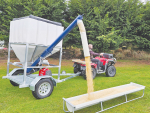
Calf feeding boost
Advantage Plastics says it is revolutionising calf meal storage and handling, making farm life easier, safer, and more efficient this season.




 increase font size
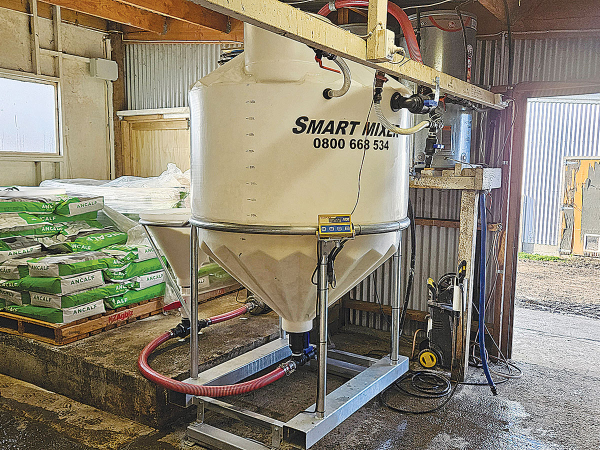 The Smart Mixer stationary mixing tank offers an easier and more efficient way to mix calf milk powder.
In the thick of calf rearing, logistics can play an important part of getting the job done quickly and efficiently.
Recently introduced by Advantage Plastics, Rangiora, the Smart Mixer stationary mixing tank offers an easier and more efficient way to mix calf milk powder, by removing the back breaking work out of manual mixing and speeding up the whole process.
Manufactured from UV stable, food grade polyethylene, the 1600l main tank features side inspection/top lid, mounted in a heavy-duty galvanised steel frame, with fork pockets for easy movement. Utilising 50mm hose and ball valves throughout, discharge is via a 25mm outlet, with complete discharge and easy clean out.
Featuring a re-circulation cone bottom tank design, an easily accessible self-loading side funnel sucks milk powder through when recirculating. Once a mix is completed, the system is ideal for filling mobile feeders/ trailers, calfaterias, buckets or coupling to a piped system installed in a calf shed. Overall dimensions are 2300mm high, 2100mm wide, 1500mm deep and loading access at 1100mm.
In operation, users fill the main tank with water and start the circulation system, then add milk powder via the side funnel hopper, which is “pulled” into the main body of water while recirculating, to quickly dissolve the powder to create and create a homogenous blend.
Calf rearer Simon Raisbeck, from Ashburton, who raises between 800 and 100 animal each season says the mixing system works well and he is especially pleased with how quickly it mixes a tank full of milk to produce a very consistent blend. “I’m finding its saving me between 15 to 20 minutes a day on mixing times”.
Advantage Plastics says it is revolutionising calf meal storage and handling, making farm life easier, safer, and more efficient this season.
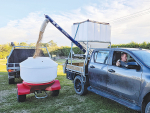
For over 20 years, Advantage Plastics has been manufacturing and supplying New Zealand-wide a large range of on-farm storage & handling equipment.
Well-known for its moulded plastic products for a range of industries, South Island-based Advantage plastics has recently added to its agricultural collection with a clever, cone-bottomed mixing/dissolving tank.



National’s pledge to introduce 19 new national standards shows the party is serious about getting Wellington out of farming, Federated Farmers says.
The National Party’s policies to make it easier to grow fresh vegetables, secure reliable water and energy and simplify farm planning are practical changes that will give growers the confidence to invest, according to Horticulture New Zealand (HortNZ).
Fonterra Co-operative Group chief financial officer Andrew Murray has resigned to take up a role outside the dairy giant.
A major move is about to get underway to improve the quality and viability of dairy beef and cattle in NZ.
Veterinarians say changes to the code of welfare for dairy cattle provides a positive foundation for improved cattle welfare across the country.
Today, 15 October, is the International Day of Rural Women, which recognises rural women’s contribution to farming, communities and the environment.



OPINION: It seems Canterbury processor Synlait is still in the doldrums.
OPINION: Get offside with New Zealand First leader Winston Peters at your own peril.




