Friday, 13 March 2026 08:55

Farmers Urged to Graze Pastures Hard Before Sowing Subterranean Clover

Written by  Staff Reporters
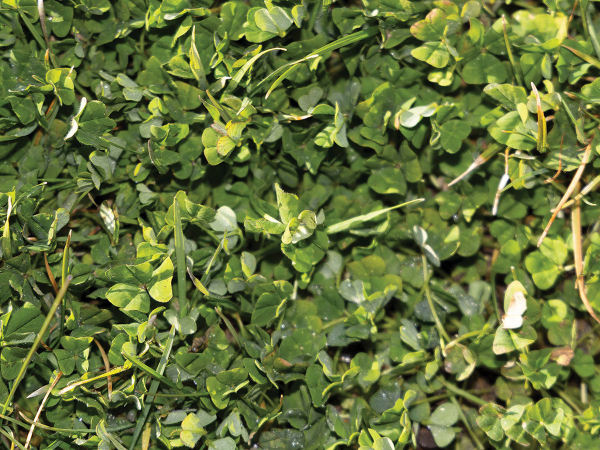
Sub clover cultivars vary considerably in flowering dates, leaf size and pest and disease tolerance. Sub clover cultivars vary considerably in flowering dates, leaf size and pest and disease tolerance.

Farmers wanting to establish subterranean clovers in their pastures this autumn are encouraged by Beef + Lamb NZ to graze pastures down to 700-1000 kg DM/ha prior to sowing.

A hard grazing in March will open up the pasture, particularly after such a growthy season, and aid the germination of oversown subterranean (sub) clover seed.

If necessary, herbicide can also be used to reduce drymatter before broadcasting or drilling seed, it says. 

Ideally, the seed should be oversown, direct-drilled or broadcast at 10 kg/ha and fertiliser applied if required.

Legumes need a soil pH greater than 5.5, an Olsen P of over 15 and sulphate-S of over 8. 

Germination is triggered by rainfall of over 20mm. Once germination has occurred, the area should be spelled to allow establishment and the seedlings to reach the trifoliate leaf stage. 

Over winter, the area can be lightly grazed, preferably by cattle, to keep the pasture at around 2000 kg DM/ha. This ensures the clover is not shaded. The area can then be used for lambing ewes before being shut up to allow reseeding in late spring. 

Establishment methods 

Because clover seed has adapted to germinate from seed burrs buried in the top 10mm of soil, drilling is the ideal method of establishment. 

Success from broadcasting seed is more weather dependent and the best results are seen when seed is spread just before a prolonged wet spell in March or April, this can be difficult to predict. Immediately after broadcasting, stock can be used to trample the seed into the ground. 

Rates and mixes 

The recommended sowing rate of 10 kg/ha will generate about 100 established sub clover plants per metre square. 

 The best way to quickly build a large sub clover seed bank is to sow the clover alone or reduce grass seed rates down to under half of what would normally be used (e.g. 8-10 kg/ha of perennial ryegrass or 2 kg/ha of cocksfoot and plantain). 

Alternatively, sub clover could be sown with rape (at 1 kg/ha or less if the soil is fertile) as the brassica will act as a nurse crop for the clover and provide a couple of grazings over winter. 

Grass can be over-drilled the following autumn, after the sub clover has set-seed. 

Cultivars 

Sub clover cultivars vary considerably in flowering dates, leaf size, pest and disease tolerance and hardseedness, so a mix of at least two complementary cultivars will compensate for site and climate variability. Luisetti Seeds has a range of sub clovers available, including Puawhaa, a variety bred specifically for New Zealand hill country environments.

As a rule of thumb, earlier flowering cultivars are better suited to low rainfall areas (under 500mm) whereas later flowering cultivars are adapted to higher rainfall areas (over 700mm). 

More like this

Autumn sub clover control sets up pasture for spring

Recent widespread autumn rain will have triggered the germination of subterranean clover seeds, and the resulting seedlings should be allowed to reach the 3–4 trifoliate leaf stage before grazing, says Beef+Lamb NZ.

The basics of grazing

OPINION: When I left school in 1962, I worked on our family farm at Tikokino, but learning about farming wasn't a priority at the time because I had other distractions on my mind, such as fast cars and hot girls.

Spelling pastures

To build resident populations of subterranean clover in hill country pastures, sheep farmers are encouraged to spell selected areas for four to five weeks over late spring and early summer if possible.

Shelter a key necessity

Mature grazing livestock are generally very well-adapted to maintain a comfortable body temperature regardless of the weather.

Featured

Agri Experts Give Their Views on 2050

Despite near universal optimism in the rural sector, a panel of New Zealand’s leading food and agri minds caution that the sector must be intentional about its future path.

The panel say this is needed if the sector is to successfully

navigate the social, economic, environmental and technological forces impacting its operating environment.

Their views form part of the latest version of Rabobank’s annual white paper ‘Succession 2050 – gearing up for New Zealand’s food and agri future’.

Experts Identify Key Global Challenges

The white paper focuses on the topic of succession at an industry level.

In addition to Rabobank’s own insights, the paper brings together a selection of 14 leading New Zealand and international food and agri experts – including trade negotiators, economists, systems analysts, scientists and technologists along with sectoral experts in sustainability, the future of fibre and Māori enterprise – to share their perspectives on what the New Zealand food and agri sector could look like in 2050 and what needs to change to achieve that vision.

Launching the new paper at the Primary Industries New Zealand Summit in Auckland today, Rabobank New Zealand CEO Todd Charteris said the experts who contributed to the white paper had identified plenty of reasons for New Zealand to be confident about its food and agri future.

“To name just a few, we’re a major food producer in a food-hungry world that’s on track to need 56% more food by 2050,” he said.

“Our food and fibre exports are also growing strongly and are forecast to hit $64.3 billion for the year to June 2026, while our government has signalled its plans to help double overall New Zealand exports by 2034.”

While there were many reasons for optimism, Charteris said, the expert contributors had also noted a host of changes taking place across the global food and agri operating environment that would need to be navigated for the industry to achieve ongoing success in the decades ahead.

“A number of key changes shaping the future of the sector came through in the perspectives of the expert contributors,” he said.

“There are the well-canvased issues of increasing global food insecurity, the challenging trade environment driven by geopolitical tensions, and the need to produce food within planetary limits."

'Identity Eating' Emerges as a Key Consumer Trend

“However, the experts also raised emerging trends, including what we’ve called ‘Identity eating’ – which is the growing way of signalling who you are as a person through what you eat – and is leading to higher demand for ethical and health-conscious foods.

“Another key trend identified out to 2050 was ‘Exponential everything’, which covers the transformation of the sector through science and technology.”

Rather than let these changes wash over it like a tsunami, Mr Charteris said, the broadly held view among the expert contributors was that New Zealand’s agriculture sector would need to lean in and proactively shape the changes occurring around it.

“We heard this message in many different ways; whether it was influencing global trade policy, embracing technology, capitalising on sustainability, training up for the future, defending our advantage in dairy or kiwifruit, growing Māori enterprise or more deliberately utilising all the wealth in our big blue backyard,” he said.

Building a 2050 growth engine for food and agri

Charteris said the white paper contributors had identified 23 changes they would like to see in New Zealand between now and 2050 that will help set up the sector for success.

“Essentially, they boil down into five buckets with four to five ‘work ons’ in each bucket,” he said.

“At the centre, we need a change model that starts from the customer perspective and works outward from that, feeding into more purposeful decisions about land use and production systems.

“Then once we are clear on what customers are asking for and where we want to play, we need to stack talent and technology.

“Between these items we have the elements of a 2050 growth engine.”

What’s exciting, Charteris said, is that New Zealand has the geography, the capacity, the ideas, and the time, to make something outstanding of its future.

“My wish is that our experts’ thinking will inspire others to join me in pushing for a more deliberative strategic future for New Zealand,” he said.

Government Mulling Plan Change 1 Intervention

The Government is looking at intervening on behalf of Waikato farmers who face new regulations around agricultural land use while Resource Management Act (RMA) reforms are underway.

National

Machinery & Products

» Latest Print Issues Online

The Hound

Great Idea!

OPINION: Central Hawke's Bay farmer Mark Warren recently told the Hawke's Bay Times it's time for a conversation about allowing…

No Choice

OPINION: A nation that relies as heavily as NZ does on functional global shipping lanes will have to do its…

» Connect with Rural News

» eNewsletter

Subscribe to our weekly newsletter