
Tongan Student Wins Final William Gearish Award
Vetekina Pau'u is the first Tongan to win the William Gearish Memorial prize and sadly she will also be the last recipient.




 increase font size
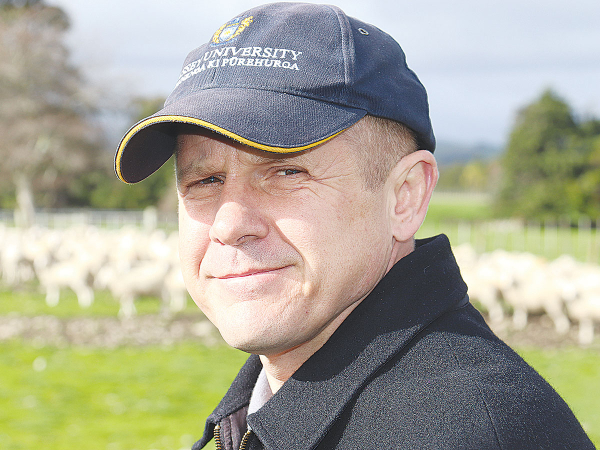 Professor Paul Kenyon
Expect greater collaboration between Massey University’s school of Agriculture and Environment and Ireland’s leading agriculture university, the University College of Dublin (UCD), in the future.
That the message from Professor Paul Kenyon who heads the Massey School and who recently returned from Ireland, where he spent three weeks at UCD in Dublin and the Irish agriculture research organisation Teagasc – one of its main sheep research stations – at Athenry near Galway city.
Kenyon’s trip was funded by the European Union and was part of a special exchange programme for academic staff and postgraduate students from the two agricultural universities.
Kenyon says for academic staff, it’s about teaching undergraduate students, and for post graduate students, it’s about spending time studying in each other’s country to understand their respective agricultural production systems and university life.
“So, I taught some undergrads and post grads at UCD in Dublin, plus I went and talked to academic staff about areas in which we have similarities in terms of interacting with high schools to attract students into our respective courses to meet current students and industry demands,” he says.
Kenyon says the second part of the trip was about collaborative research and seeing other sheep and beef projects underway in Ireland. He says Massey and UCD already have collaborate programmes running, in particular with Professor Tommy Boland of UCD who’s been to NZ many times.
Kenyon says he was keen to learn about what programmes – especially of a commercial nature –
UCD is involved at its Lyons research farm just out of Dublin and the Teagasc research station.
“At Athenry, I spent time with an Irish PhD student that I co-supervise in conjunction with UCD who’s looking at pasture swards and the use of greater levels of clover. I had a good chat to her and then I took the opportunity to look at more opportunities for collaboration between the two countries,” he says.
Joint Research
Ireland and NZ have much in common; both have pastoral-based systems and have to deal with similar issues in the environmental and animal production space. Paul Kenyon says that both countries can learn a lot from each other by greater collaboration.
“The advantage of working collaboratively [is] that we can do research faster because we operate in different hemispheres and effectively get two springs within the space of 12 months,” he says.
A big part of Kenyon’s Ireland trip was to firm up a student exchange programme between UCD and Massey. He says four Irish PhD students will spend three or four months at Massey and a NZ student will be going to UCD and their Lyons research farm early this year.
Kenyon says one of the roles of his trip has been to connect people in UCD and other organisations, many of whom were not directly related to the specific aims of this trip.
“I forged linkages and collaborations that hopefully others will take up for the benefit of both countries,” he says.
The big end game in this collaboration programme is to source funding for future research. Professor Kenyon says there are international funding bodies who are looking to invest in collaborative research – especially if the partners are from different hemispheres. He says both UCD and Massey, both leading agricultural universities in their respective countries, are keen to tap into these funding sources and understand what each is doing to ensure that high quality bids for funding are made.
Vetekina Pau'u is the first Tongan to win the William Gearish Memorial prize and sadly she will also be the last recipient.
Researchers at Massey University are using a special piece of scientific equipment to improve the measurement of greenhouse gas emissions from pasture soils.
Interest in agritech and production animal systems has prompted Massey University's School of Agriculture and the Environment to new majors to its popular animal science degree.
The industry is crying out for graduates with agricultural related degrees.
A four year trial has reaffirmed that mixing plantain into dairy pastures can help reduce nitrogen losses to freshwater while maintaining milk production and profitability, say researchers.



Alliance is calling for final applications for its 2027 Graduate Programme, with applications closing on Sunday 25 October.
Decades piloting planes has ensured vet and farmer David Hayes is focused on safety. So, after a serious accident while welding on farm, he is sharing his experience so others can learn from it.
Canterbury milk processor, Synlait Milk has confirmed Leon Fung as its chief executive officer.
OPINION: Making it easier to collect rainwater and use it to grow crops and livestock is a no brainer.
As part of its Election 2026 coverage, Rural News asked political parties how they would help pull the arable sector out of the doldrums. Here's what they said:
Farmers are being encouraged to rethink how they manage waste on farm with the launch of ruralwastesorted.co.nz, a new website bringing together practical tips, real farmer experiences and resources.

OPINION: The same mainstream media muppets that brought you Jacindamania in 2017 have been flat out pimping for the Opportunities…
OPINION: Your old mate reckons the atrocious way farmers in the UK are treated by their lords and masters in…




